 BJP-PDP Alliance Ends[/caption]
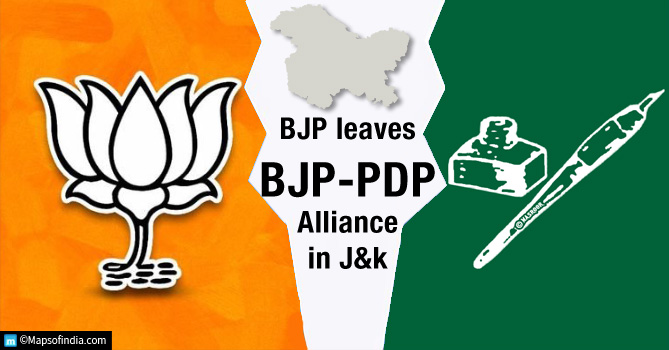
Indian politics can spring surprises from political bickering, power sharing arrangements to forming unusual alliances. In 2014, after BJP won the General elections with a comprehensive mandate, the party went on to record its highest tally in the J&K State Assembly elections, while Peoples Democratic Party (PDP) emerged as the single largest party in the valley. However, all sections of the political class and society were left dazed and confused, when BJP extended its support to Mehbooba Mufti's PDP, forming an unusual alliance with no ideological affinity. For three and a half years the outlandish alliance was in power, although, with every passing year the distance grew between BJP and PDP. A year before the turbulent state of Jammu & Kashmir was supposed to go for polls, BJP pulled out of the alliance leaving the political situation in the valley in doldrums.
The reason behind BJP pulling out of the alliance
The Bharatiya Janata Party withdrew its support from the PDP-BJP government in J&K on Tuesday, after three and a half years in power. The withdrawal of support left the Mehbooba Mufti's PDP short of majority, thus, forcing her into filing resignation after she heard about it from J&K Governor N N Vohra. He will overlook the functioning of the government until the next government is formed, J&K Governor has seen Governor's Rule imposed in the state thrice during his tenure.
Following are some of the reasons behind the BJPs decision to break the alliance:
BJP-PDP Alliance Ends[/caption]
Indian politics can spring surprises from political bickering, power sharing arrangements to forming unusual alliances. In 2014, after BJP won the General elections with a comprehensive mandate, the party went on to record its highest tally in the J&K State Assembly elections, while Peoples Democratic Party (PDP) emerged as the single largest party in the valley. However, all sections of the political class and society were left dazed and confused, when BJP extended its support to Mehbooba Mufti's PDP, forming an unusual alliance with no ideological affinity. For three and a half years the outlandish alliance was in power, although, with every passing year the distance grew between BJP and PDP. A year before the turbulent state of Jammu & Kashmir was supposed to go for polls, BJP pulled out of the alliance leaving the political situation in the valley in doldrums.
The reason behind BJP pulling out of the alliance
The Bharatiya Janata Party withdrew its support from the PDP-BJP government in J&K on Tuesday, after three and a half years in power. The withdrawal of support left the Mehbooba Mufti's PDP short of majority, thus, forcing her into filing resignation after she heard about it from J&K Governor N N Vohra. He will overlook the functioning of the government until the next government is formed, J&K Governor has seen Governor's Rule imposed in the state thrice during his tenure.
Following are some of the reasons behind the BJPs decision to break the alliance:
- One of the major reasons stated by the BJP was the deteriorating security situation in the state.
- The state observed a month's unilateral ceasefire during the Ramadan after CM Mehbooba Mufti came up with the idea to bring peace in the state. However, the Centre and BJP were not willing to extend the period beyond Ramadan.
- The recent Kathua rape and murder case that jolted not only the state of J&K but the whole country became a point of conflict between both the parties. The inhumane murder and rape of an 8-year-old child from the Muslim Bakerwal community led to unrest in the state. The issue intensified when the BJPs state members raised doubts over the police investigation and two members raised their voice in support of the accused.
- The removal of Armed Forces Special Powers Act (AFSPA) was a bone of contention between BJP and PDP, as the former felt removal of AFSPA can prove to be disastrous, while the latter felt that removal can usher in new era of peace and stability in the state.
- With Mehbooba Mufti resigning from the office of Chief Minister of Jammu & Kashmir, state's Governor N N Vohra will take charge of the functioning of the state during the crisis until AmarnathYatra convenes.
- This will allow the Centre to indirectly control the functioning of the state, while giving a free-hand to the army and police to continue their anti-terror operations in the state with more impetus.
- The state that has been at unrest since the day India attained independence, will be without an elected government to run the state until a viable option of government formation pops up.
- The current political crisis would lead to unrest across the state, as insurgents and stone pelters would be looking to capitalise on the situation, while the Indian Army will be looking to make inroads with anti-insurgency plans to counter the insurgents and separatists.