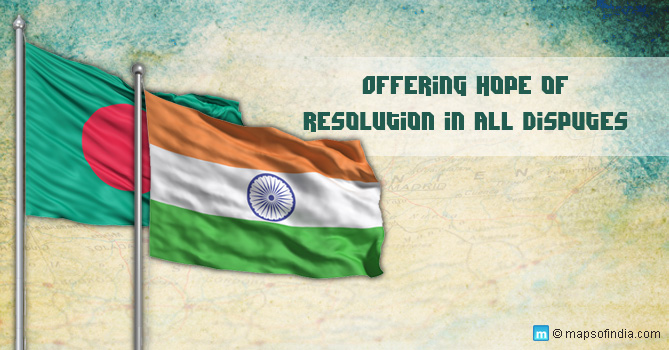
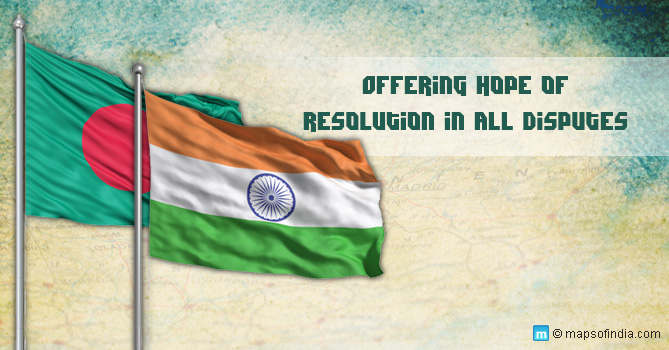
 At one minute past midnight on the night of 31 July – 01 August 2015, it will be freedom finally, for the stateless people living in a narrow tract of land between India and Bangladesh. These unfortunate victims of history have lived for 68 years without a national identity, with neither country extending any benefit or services to these people.
An unfortunate fallout of Partition in 1947 was that certain enclaves claimed by Bangladesh remained physically under Indian control, while other enclaves claimed by India remained under Bangladeshi control, but the people residing in these enclaves remained unclaimed by either country. The territorial dispute with erstwhile East Pakistan was extended to Bangladesh when it won its independence in 1971, and finally, in 1974, the Land Border Agreement (LBA) was negotiated between the two countries. But political factors on both sides held back the formal agreement and it was only during Prime Minister Modi’s historic visit to Bangladesh, that the Land Border Agreement (LBA) was formally signed.
Under the LBA, India is to get 111 enclaves comprising 17,160 acres of land, while India will hand over to Bangladesh 51 enclaves comprising 7,110 acres. In order to ensure a smooth transition in an orderly manner, both countries agreed to hold a joint survey in all the 162 disputed enclaves to determine local resident’s choice as to which country they wish to belong, once the enclaves were exchanged.
The exchange of enclaves is not a simple process as many factors have to be sorted out. For instance, what happens to the property of a family that chooses the citizenship of the other country and vice versa? How do they get compensated and at what value? What about those properties where the owner in whose name(s) it is registered, is no more? And then, there may be properties where the land ownership documents are incomplete or vague. How are these to be resolved?
In order to address all these issues, both governments have agreed to give a time of one year i.e. up to 30 June 2016, to ensure all people are able to resolve and settle property matters and shift to their respective countries. The governments on their part are planning to list all properties on a website with relevant information that will help people make the sale and transfer.
At one minute past midnight on the night of 31 July – 01 August 2015, it will be freedom finally, for the stateless people living in a narrow tract of land between India and Bangladesh. These unfortunate victims of history have lived for 68 years without a national identity, with neither country extending any benefit or services to these people.
An unfortunate fallout of Partition in 1947 was that certain enclaves claimed by Bangladesh remained physically under Indian control, while other enclaves claimed by India remained under Bangladeshi control, but the people residing in these enclaves remained unclaimed by either country. The territorial dispute with erstwhile East Pakistan was extended to Bangladesh when it won its independence in 1971, and finally, in 1974, the Land Border Agreement (LBA) was negotiated between the two countries. But political factors on both sides held back the formal agreement and it was only during Prime Minister Modi’s historic visit to Bangladesh, that the Land Border Agreement (LBA) was formally signed.
Under the LBA, India is to get 111 enclaves comprising 17,160 acres of land, while India will hand over to Bangladesh 51 enclaves comprising 7,110 acres. In order to ensure a smooth transition in an orderly manner, both countries agreed to hold a joint survey in all the 162 disputed enclaves to determine local resident’s choice as to which country they wish to belong, once the enclaves were exchanged.
The exchange of enclaves is not a simple process as many factors have to be sorted out. For instance, what happens to the property of a family that chooses the citizenship of the other country and vice versa? How do they get compensated and at what value? What about those properties where the owner in whose name(s) it is registered, is no more? And then, there may be properties where the land ownership documents are incomplete or vague. How are these to be resolved?
In order to address all these issues, both governments have agreed to give a time of one year i.e. up to 30 June 2016, to ensure all people are able to resolve and settle property matters and shift to their respective countries. The governments on their part are planning to list all properties on a website with relevant information that will help people make the sale and transfer.
At one minute past midnight on the night of 31 July – 01 August 2015, it will be freedom finally, for the stateless people living in a narrow tract of land between India and Bangladesh. These unfortunate victims of history have lived for 68 years without a national identity, with neither country extending any benefit or services to these people.
An unfortunate fallout of Partition in 1947 was that certain enclaves claimed by Bangladesh remained physically under Indian control, while other enclaves claimed by India remained under Bangladeshi control, but the people residing in these enclaves remained unclaimed by either country. The territorial dispute with erstwhile East Pakistan was extended to Bangladesh when it won its independence in 1971, and finally, in 1974, the Land Border Agreement (LBA) was negotiated between the two countries. But political factors on both sides held back the formal agreement and it was only during Prime Minister Modi’s historic visit to Bangladesh, that the Land Border Agreement (LBA) was formally signed.
Under the LBA, India is to get 111 enclaves comprising 17,160 acres of land, while India will hand over to Bangladesh 51 enclaves comprising 7,110 acres. In order to ensure a smooth transition in an orderly manner, both countries agreed to hold a joint survey in all the 162 disputed enclaves to determine local resident’s choice as to which country they wish to belong, once the enclaves were exchanged.
The exchange of enclaves is not a simple process as many factors have to be sorted out. For instance, what happens to the property of a family that chooses the citizenship of the other country and vice versa? How do they get compensated and at what value? What about those properties where the owner in whose name(s) it is registered, is no more? And then, there may be properties where the land ownership documents are incomplete or vague. How are these to be resolved?
In order to address all these issues, both governments have agreed to give a time of one year i.e. up to 30 June 2016, to ensure all people are able to resolve and settle property matters and shift to their respective countries. The governments on their part are planning to list all properties on a website with relevant information that will help people make the sale and transfer.
At one minute past midnight on the night of 31 July – 01 August 2015, it will be freedom finally, for the stateless people living in a narrow tract of land between India and Bangladesh. These unfortunate victims of history have lived for 68 years without a national identity, with neither country extending any benefit or services to these people.
An unfortunate fallout of Partition in 1947 was that certain enclaves claimed by Bangladesh remained physically under Indian control, while other enclaves claimed by India remained under Bangladeshi control, but the people residing in these enclaves remained unclaimed by either country. The territorial dispute with erstwhile East Pakistan was extended to Bangladesh when it won its independence in 1971, and finally, in 1974, the Land Border Agreement (LBA) was negotiated between the two countries. But political factors on both sides held back the formal agreement and it was only during Prime Minister Modi’s historic visit to Bangladesh, that the Land Border Agreement (LBA) was formally signed.
Under the LBA, India is to get 111 enclaves comprising 17,160 acres of land, while India will hand over to Bangladesh 51 enclaves comprising 7,110 acres. In order to ensure a smooth transition in an orderly manner, both countries agreed to hold a joint survey in all the 162 disputed enclaves to determine local resident’s choice as to which country they wish to belong, once the enclaves were exchanged.
The exchange of enclaves is not a simple process as many factors have to be sorted out. For instance, what happens to the property of a family that chooses the citizenship of the other country and vice versa? How do they get compensated and at what value? What about those properties where the owner in whose name(s) it is registered, is no more? And then, there may be properties where the land ownership documents are incomplete or vague. How are these to be resolved?
In order to address all these issues, both governments have agreed to give a time of one year i.e. up to 30 June 2016, to ensure all people are able to resolve and settle property matters and shift to their respective countries. The governments on their part are planning to list all properties on a website with relevant information that will help people make the sale and transfer.