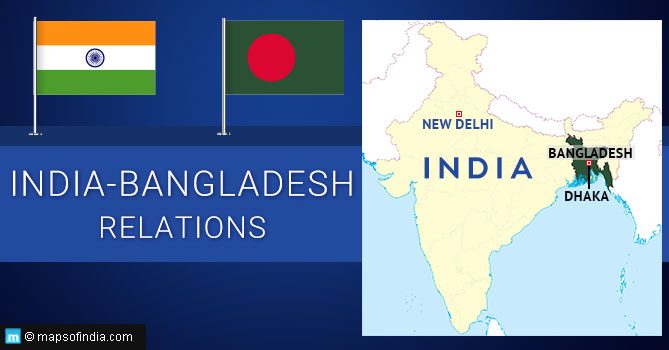
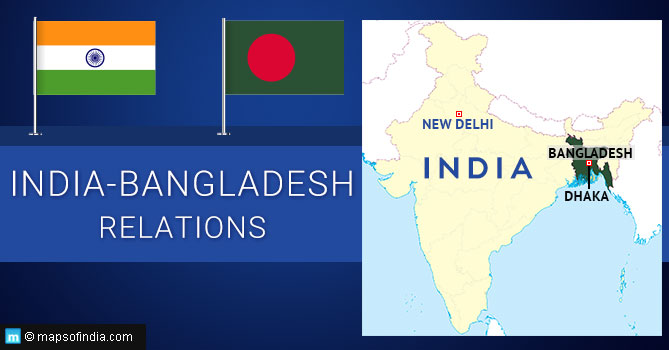
- Boundary Dispute India shares a 4351 km long land border with Bangladesh running through five states, viz., West Bengal (2217kms), Assam (262 kms), Meghalaya (443kms), Tripura (856 kms) and Mizoram (318 kms), as per the Ministry of Defence. The border crosses through 25 districts in 5 states. The porous borders are often used as a route for smuggling food items, livestock, drugs and medicines from India to Bangladesh. Thousands of illegal immigrants from Bangladesh have crossed the border to India over the years in search of employment and improving their lives. The contentious shoot-at-sight policy has been enforced by the Indian border patrol police to counter reported violence between the illegal migrants and Indian soldiers.
- Water Dispute India and Bangladesh share 54 trans-border rivers, varying in sizes. 1996 was an important year for both the countries as they reached an agreement successfully on sharing of the Ganga waters. However, the major dispute that has become a bone of contention has been India’s plans to construct and operate the Farakka Barrage. The construction of Farakka Barrage is aimed at increasing the lean period flow of the Bhagirathi-Hooghly branch of river Ganga so as to increase the water depth at the Kolkata port which has been threatened by siltation. However, as the irrigation withdrawals increased in Bangladesh, the sharing of the lean season flow at Farakka became a dispute between India and Bangladesh. The inadequate water during the lean season is unable to meet the assessed demands in the two countries became the root cause of conflict between bordering countries.
- Illegal Migrations Illegal migration has been the most problematic issue between these two countries. Since 1971, when war of independence broke out that led to the creation of Bangladesh, millions of Bangladeshi immigrants (the vast majority of them illegal) crossed into the neighbouring states in India. Even though, the Indian government tried to deport some of these illegal immigrants, but the large number of immigrants, as well as the porous border between the two countries, has made the efforts of Indian government impossible. At least 10-million Bangladeshis poured into the state of West Bengal in India at the time Bangladesh's independence. The most affected regions are the eastern and north-eastern parts of the country. Illegal immigrants pose a direct threat to the country’s internal security, while also impacting the social fabrication in the northeast of India.
- Security Concerns Over the years, insurgency has strained the relations between India and Bangladesh. Since 1956, Northeast India has been the worst hit region facing insurgency due to growing ethnic separatism among the inhabitants. Pakistan's intelligence agency, ISI has been accused of operating from Bangladesh, infiltrating and supporting the insurgents in the Northeast India. Liberation Front of Assam (ULFA), National Liberation of Tripura (NLFT) and National Democratic Front of Bodoland (NDFM) are major insurgent groups that have created an atmosphere of terror in Northeast India.