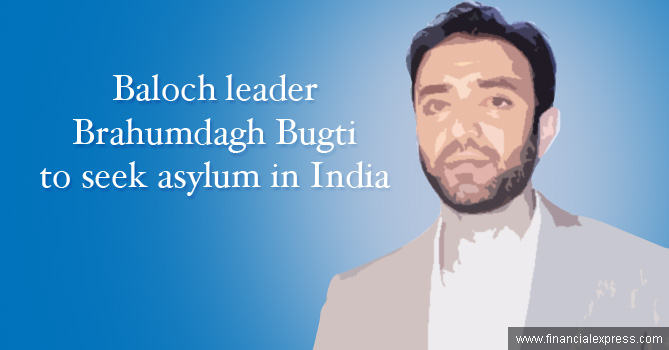
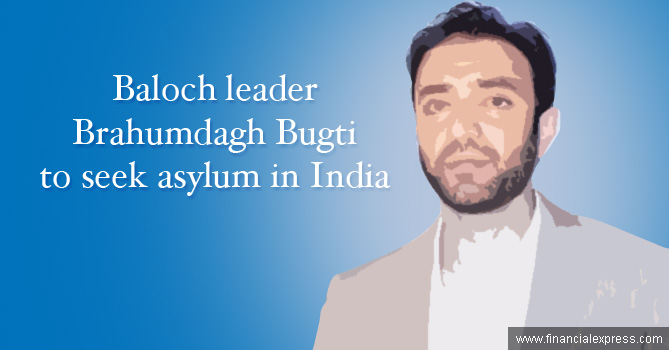
 Baloch leader, Brahumdagh Bugti, grandson of Nawab Akbar Bugti, has decided to seek political asylum in India. President of Baloch Republican Party (BRP), and head of the Bugtis — the largest tribe of Balochistan, Brahumdagh Bugti has been residing in Geneva under his Afghan passport since he fled Balochistan in 2006 after the assassination of his grandfather in 2006, during the presidency of General Pervez Musharraf. However, he is forbidden to engage in political activities while in Switzerland.
The decision to initiate legal proceedings for fulfilling the asylum procedure with the Indian Government was arrived at after a meeting of BRP, which examined and cleared the need to shift to India. Azizullah Bugti, a spokesperson of the BRP stated, “Baloch Republican Party’s Central Committee has ratified Mr. Bugti’s decision to seek political asylum in India. At the moment, we are concerned about the safety of the president of the party and that is why the decision for political asylum was cleared. We have not yet decided who all will accompany him on his journey to India, but that is up to him to decide and the party will volunteer members to accompany him to India as the need arises.”
Earlier this month, Bugti had expressed his desire for India’s support in his quest for the independence of his homeland from Pakistan. Citing examples of the support extended to Dalai Lama and Sheikh Mujibur Rahman, Bugti hoped that India would extend the same support when the need arose.
Know More About The Province of Balochistan
Balochistan constitutes of one of the four provinces of Pakistan. With an area covering 44% of the total area, which is nearly half of Pakistan, Balochistan is the largest province in the country, and has a population of 1.3 crore, constituting only 7% of the total population of Pakistan. Here are a few things you should know to understand the ongoing problem in Balochistan.
Baloch leader, Brahumdagh Bugti, grandson of Nawab Akbar Bugti, has decided to seek political asylum in India. President of Baloch Republican Party (BRP), and head of the Bugtis — the largest tribe of Balochistan, Brahumdagh Bugti has been residing in Geneva under his Afghan passport since he fled Balochistan in 2006 after the assassination of his grandfather in 2006, during the presidency of General Pervez Musharraf. However, he is forbidden to engage in political activities while in Switzerland.
The decision to initiate legal proceedings for fulfilling the asylum procedure with the Indian Government was arrived at after a meeting of BRP, which examined and cleared the need to shift to India. Azizullah Bugti, a spokesperson of the BRP stated, “Baloch Republican Party’s Central Committee has ratified Mr. Bugti’s decision to seek political asylum in India. At the moment, we are concerned about the safety of the president of the party and that is why the decision for political asylum was cleared. We have not yet decided who all will accompany him on his journey to India, but that is up to him to decide and the party will volunteer members to accompany him to India as the need arises.”
Earlier this month, Bugti had expressed his desire for India’s support in his quest for the independence of his homeland from Pakistan. Citing examples of the support extended to Dalai Lama and Sheikh Mujibur Rahman, Bugti hoped that India would extend the same support when the need arose.
Know More About The Province of Balochistan
Balochistan constitutes of one of the four provinces of Pakistan. With an area covering 44% of the total area, which is nearly half of Pakistan, Balochistan is the largest province in the country, and has a population of 1.3 crore, constituting only 7% of the total population of Pakistan. Here are a few things you should know to understand the ongoing problem in Balochistan.
- Balochistan is strategically located and has shared borders with Punjab, Sindh, FATA, as well as Afghanistan and Iran.
- Balochistan is also home to the Gwadar Port, which is of immense importance to Pakistan.
- The land itself is very rich in natural resources including oil, gas, copper and gold; the economy is dominated by its natural gas fields.
- The inhabitants of Balochistan mainly consist of the tribese Baloch, Pashtuns and Brahuis.
- The people of Baloch are ethnically, culturally and socially different from the rest of Pakistan and feel dominated at the hands of the Punjabis.
- Though mineral rich, the province is poor and very backward even today.
- Pre-Independence, the land of Baloch was divided into 4 princely states.
- When Pakistan was born in 1947, the princely states refused to join the new nation.
- Pakistan forcefully annexed Balochistan in March 1948.
- Though the ruler then, Yar Khan signed a treaty of accession, his brothers and followers continued to fight this accession, which saw five waves of insurgencies in 1958, 1962-63, and 1973-77.
- Violent campaigns were held to gain independence from Pakistan.
- Post 1977, peace reigned for 2 decades; tensions started building up after General Pervez Musharraf seized power in 1999.
- The military, under the leadership of Musharraf, started building new cantonments in Balochistan.
- This move by the military was seen as a bid to tighten control over the province by the radical nationalist factions.
- This time the fifth wave of insurgency erupted and it still continues to be on.
- Of the radical nationalist factions, Balochistan Liberation Army (BLA), led by Brahumdagh Bugti, is the strongest and has been designated as a terrorist group by Pakistan with claims that India is backing BLA.
- The BLA has conducted several attacks on the Pakistani security forces and civilians over the years in retaliation of Pakistani atrocities, the bid of Pakistan to keep the Baloch suppressed.
- Pakistani security forces are accused of detaining 19,000 men, women and children over the past 2 decades illegally and many of the detained have been raped and killed.
- The Pakistani atrocities in the province had attracted international condemnation. “The surge in unlawful killings of suspected militants and opposition figures in Balochistan has taken the brutality in the province to an unprecedented level,” said Brad Adams, Asia Director at Human Rights Watch, in a July 2011 report.
- Balochistan holds a position of great importance in Pakistan’s future economic and geopolitical strategies.
- The province is one of the important locations in the proposed economic corridor at an investment of $46 billion by China, which aims to link the deepwater port of Gwadar with the city of Kashgar, a trading hub in the western Chinese region of Xinjiang.
- The proposed Iran-Pakistan gas pipeline is also planned to go through Balochistan.