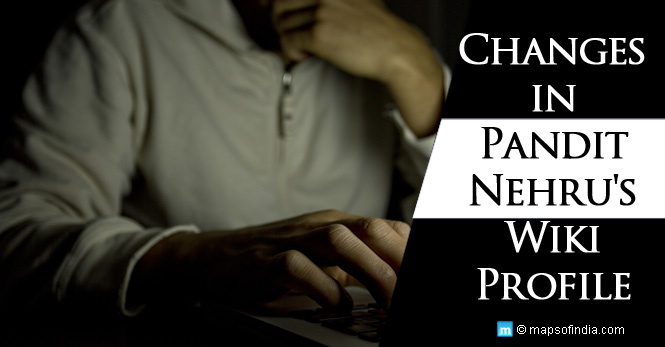
 'Mischievous' changes were made to India’s first Prime Minister Jawaharlal Nehru's Wikipedia profile by an anonymous person on 26 June 2015. It was immediately noticed by a software designed to highlight such anonymous changes. We all know Wikipedia to be a platform for information content that is governed by Creative Commons Attribution, which offers anyone the right to add new information or add to existing content and use the available information free of charge. That’s what made Wikipedia so popular and continuously grow as a major source for content.
So, why someone’s edit on Pandit Nehru’s profile raise so many eyebrows and evoke such a passionate protest? Isn’t that supposed to be a norm when it comes to Wikipedia? Well, the act is controversial on three counts. Firstly, it was an anonymous editor who made the changes. The Wiki editors must disclose their identity. Secondly, the changes were downright malicious as was the intent, and aimed at a person respected by many in India. Thirdly, the source of the IP address from where the changes were made was traced back to an IP address belonging to National Informatics Centre (NIC), a central government agency for web services.
'Mischievous' changes were made to India’s first Prime Minister Jawaharlal Nehru's Wikipedia profile by an anonymous person on 26 June 2015. It was immediately noticed by a software designed to highlight such anonymous changes. We all know Wikipedia to be a platform for information content that is governed by Creative Commons Attribution, which offers anyone the right to add new information or add to existing content and use the available information free of charge. That’s what made Wikipedia so popular and continuously grow as a major source for content.
So, why someone’s edit on Pandit Nehru’s profile raise so many eyebrows and evoke such a passionate protest? Isn’t that supposed to be a norm when it comes to Wikipedia? Well, the act is controversial on three counts. Firstly, it was an anonymous editor who made the changes. The Wiki editors must disclose their identity. Secondly, the changes were downright malicious as was the intent, and aimed at a person respected by many in India. Thirdly, the source of the IP address from where the changes were made was traced back to an IP address belonging to National Informatics Centre (NIC), a central government agency for web services.
'Mischievous' changes were made to India’s first Prime Minister Jawaharlal Nehru's Wikipedia profile by an anonymous person on 26 June 2015. It was immediately noticed by a software designed to highlight such anonymous changes. We all know Wikipedia to be a platform for information content that is governed by Creative Commons Attribution, which offers anyone the right to add new information or add to existing content and use the available information free of charge. That’s what made Wikipedia so popular and continuously grow as a major source for content.
So, why someone’s edit on Pandit Nehru’s profile raise so many eyebrows and evoke such a passionate protest? Isn’t that supposed to be a norm when it comes to Wikipedia? Well, the act is controversial on three counts. Firstly, it was an anonymous editor who made the changes. The Wiki editors must disclose their identity. Secondly, the changes were downright malicious as was the intent, and aimed at a person respected by many in India. Thirdly, the source of the IP address from where the changes were made was traced back to an IP address belonging to National Informatics Centre (NIC), a central government agency for web services.
'Mischievous' changes were made to India’s first Prime Minister Jawaharlal Nehru's Wikipedia profile by an anonymous person on 26 June 2015. It was immediately noticed by a software designed to highlight such anonymous changes. We all know Wikipedia to be a platform for information content that is governed by Creative Commons Attribution, which offers anyone the right to add new information or add to existing content and use the available information free of charge. That’s what made Wikipedia so popular and continuously grow as a major source for content.
So, why someone’s edit on Pandit Nehru’s profile raise so many eyebrows and evoke such a passionate protest? Isn’t that supposed to be a norm when it comes to Wikipedia? Well, the act is controversial on three counts. Firstly, it was an anonymous editor who made the changes. The Wiki editors must disclose their identity. Secondly, the changes were downright malicious as was the intent, and aimed at a person respected by many in India. Thirdly, the source of the IP address from where the changes were made was traced back to an IP address belonging to National Informatics Centre (NIC), a central government agency for web services.