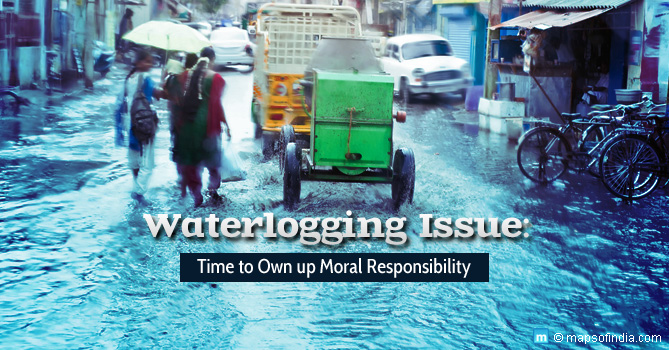
 The annual problem of waterlogging during monsoons is back in Delhi, as is the blame game that follows. It’s sad to see how tolerant people of the city have become regarding the sheer cussedness of their leaders that they vote for. In equal measure, the leaders too have become insular to the perpetual annual problem knowing perfectly well that the media will make the usual noise and people will raise the odd protest, but this too will pass, once the rains get over and it will be back to business as usual. That’s the way it has been for Delhi, year after year.
The last couple of days in July have seen Delhi receive record rains, resulting in severe waterlogging in many parts and causing traffic jams across the city. In 36 hours, Delhi received over 200 mm rain that proved too much for the city to handle. Unlike other cities in the country that also face severe waterlogging during monsoons, life in Delhi comes to a chaotic standstill even with mild showers. As it happens, the city is just not geared to handle rains, let alone waterlogging.
Low-lying areas along the Yamuna like Yamuna Pushta and Yamuna Vihar traditionally suffer the most, as people need to be evacuated to safer areas each year. This year too was no different, with the Yamuna already flowing near danger levels.
NDMC reported receiving over 90 complaints from areas like Wazirabad, Mori Gate, Jama Masjid, East Patel Nagar, Nangloi, Bawana Gaushala, Pitampura, Rohini and Paschim Vihar.
Traffic jams were reported all over Delhi with the both Ring Road and Outer Ring Road choking at various points. Travellers missed their flights out of Delhi, while many couldn’t make it in time to catch the trains leaving the city. Other people to suffer the most were patients trying to move to and fro from hospitals. Trees were seen uprooted at many places that only added to the woes of the much harried citizens. None of which is new to Delhi and yet no permanent solution has been sought thus far.
The annual problem of waterlogging during monsoons is back in Delhi, as is the blame game that follows. It’s sad to see how tolerant people of the city have become regarding the sheer cussedness of their leaders that they vote for. In equal measure, the leaders too have become insular to the perpetual annual problem knowing perfectly well that the media will make the usual noise and people will raise the odd protest, but this too will pass, once the rains get over and it will be back to business as usual. That’s the way it has been for Delhi, year after year.
The last couple of days in July have seen Delhi receive record rains, resulting in severe waterlogging in many parts and causing traffic jams across the city. In 36 hours, Delhi received over 200 mm rain that proved too much for the city to handle. Unlike other cities in the country that also face severe waterlogging during monsoons, life in Delhi comes to a chaotic standstill even with mild showers. As it happens, the city is just not geared to handle rains, let alone waterlogging.
Low-lying areas along the Yamuna like Yamuna Pushta and Yamuna Vihar traditionally suffer the most, as people need to be evacuated to safer areas each year. This year too was no different, with the Yamuna already flowing near danger levels.
NDMC reported receiving over 90 complaints from areas like Wazirabad, Mori Gate, Jama Masjid, East Patel Nagar, Nangloi, Bawana Gaushala, Pitampura, Rohini and Paschim Vihar.
Traffic jams were reported all over Delhi with the both Ring Road and Outer Ring Road choking at various points. Travellers missed their flights out of Delhi, while many couldn’t make it in time to catch the trains leaving the city. Other people to suffer the most were patients trying to move to and fro from hospitals. Trees were seen uprooted at many places that only added to the woes of the much harried citizens. None of which is new to Delhi and yet no permanent solution has been sought thus far.
The annual problem of waterlogging during monsoons is back in Delhi, as is the blame game that follows. It’s sad to see how tolerant people of the city have become regarding the sheer cussedness of their leaders that they vote for. In equal measure, the leaders too have become insular to the perpetual annual problem knowing perfectly well that the media will make the usual noise and people will raise the odd protest, but this too will pass, once the rains get over and it will be back to business as usual. That’s the way it has been for Delhi, year after year.
The last couple of days in July have seen Delhi receive record rains, resulting in severe waterlogging in many parts and causing traffic jams across the city. In 36 hours, Delhi received over 200 mm rain that proved too much for the city to handle. Unlike other cities in the country that also face severe waterlogging during monsoons, life in Delhi comes to a chaotic standstill even with mild showers. As it happens, the city is just not geared to handle rains, let alone waterlogging.
Low-lying areas along the Yamuna like Yamuna Pushta and Yamuna Vihar traditionally suffer the most, as people need to be evacuated to safer areas each year. This year too was no different, with the Yamuna already flowing near danger levels.
NDMC reported receiving over 90 complaints from areas like Wazirabad, Mori Gate, Jama Masjid, East Patel Nagar, Nangloi, Bawana Gaushala, Pitampura, Rohini and Paschim Vihar.
Traffic jams were reported all over Delhi with the both Ring Road and Outer Ring Road choking at various points. Travellers missed their flights out of Delhi, while many couldn’t make it in time to catch the trains leaving the city. Other people to suffer the most were patients trying to move to and fro from hospitals. Trees were seen uprooted at many places that only added to the woes of the much harried citizens. None of which is new to Delhi and yet no permanent solution has been sought thus far.
The annual problem of waterlogging during monsoons is back in Delhi, as is the blame game that follows. It’s sad to see how tolerant people of the city have become regarding the sheer cussedness of their leaders that they vote for. In equal measure, the leaders too have become insular to the perpetual annual problem knowing perfectly well that the media will make the usual noise and people will raise the odd protest, but this too will pass, once the rains get over and it will be back to business as usual. That’s the way it has been for Delhi, year after year.
The last couple of days in July have seen Delhi receive record rains, resulting in severe waterlogging in many parts and causing traffic jams across the city. In 36 hours, Delhi received over 200 mm rain that proved too much for the city to handle. Unlike other cities in the country that also face severe waterlogging during monsoons, life in Delhi comes to a chaotic standstill even with mild showers. As it happens, the city is just not geared to handle rains, let alone waterlogging.
Low-lying areas along the Yamuna like Yamuna Pushta and Yamuna Vihar traditionally suffer the most, as people need to be evacuated to safer areas each year. This year too was no different, with the Yamuna already flowing near danger levels.
NDMC reported receiving over 90 complaints from areas like Wazirabad, Mori Gate, Jama Masjid, East Patel Nagar, Nangloi, Bawana Gaushala, Pitampura, Rohini and Paschim Vihar.
Traffic jams were reported all over Delhi with the both Ring Road and Outer Ring Road choking at various points. Travellers missed their flights out of Delhi, while many couldn’t make it in time to catch the trains leaving the city. Other people to suffer the most were patients trying to move to and fro from hospitals. Trees were seen uprooted at many places that only added to the woes of the much harried citizens. None of which is new to Delhi and yet no permanent solution has been sought thus far.