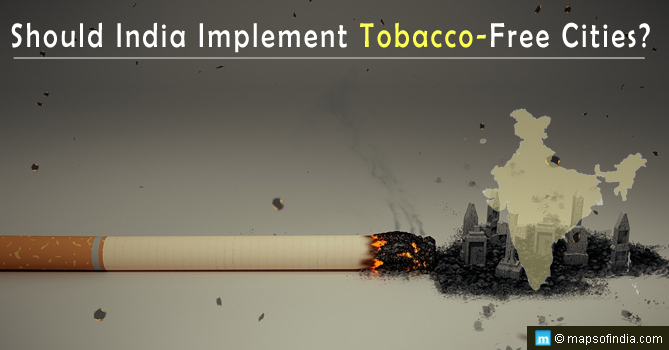
 Keeping in mind the health and welfare of its citizens, there is an increased need of declaring more cities smoke and tobacco-free in India.[/caption]
World Health Organisation’s (WHO) report has pointed out that the prevalence of smoking tobacco has dropped significantly from 19.4% to 11.5% during 2000-2005. The report also projects a further drop to 9.8% and 8.5% by 2020 and 2025 respectively. As a part of the Tobacco Free Initiative, a 52-page research article was published by the WHO – “Making cities smoke-free”. As cities can pass legislation more swiftly than at the national level, the notion of tobacco-free cities came into existence. To provide Indian citizens a better quality of life, it has become a necessity for India to consider tobacco-free cities.
Keeping in mind the health and welfare of its citizens, there is an increased need of declaring more cities smoke and tobacco-free in India.[/caption]
World Health Organisation’s (WHO) report has pointed out that the prevalence of smoking tobacco has dropped significantly from 19.4% to 11.5% during 2000-2005. The report also projects a further drop to 9.8% and 8.5% by 2020 and 2025 respectively. As a part of the Tobacco Free Initiative, a 52-page research article was published by the WHO – “Making cities smoke-free”. As cities can pass legislation more swiftly than at the national level, the notion of tobacco-free cities came into existence. To provide Indian citizens a better quality of life, it has become a necessity for India to consider tobacco-free cities.
Keeping in mind the health and welfare of its citizens, there is an increased need of declaring more cities smoke and tobacco-free in India.[/caption]
World Health Organisation’s (WHO) report has pointed out that the prevalence of smoking tobacco has dropped significantly from 19.4% to 11.5% during 2000-2005. The report also projects a further drop to 9.8% and 8.5% by 2020 and 2025 respectively. As a part of the Tobacco Free Initiative, a 52-page research article was published by the WHO – “Making cities smoke-free”. As cities can pass legislation more swiftly than at the national level, the notion of tobacco-free cities came into existence. To provide Indian citizens a better quality of life, it has become a necessity for India to consider tobacco-free cities.
Keeping in mind the health and welfare of its citizens, there is an increased need of declaring more cities smoke and tobacco-free in India.[/caption]
World Health Organisation’s (WHO) report has pointed out that the prevalence of smoking tobacco has dropped significantly from 19.4% to 11.5% during 2000-2005. The report also projects a further drop to 9.8% and 8.5% by 2020 and 2025 respectively. As a part of the Tobacco Free Initiative, a 52-page research article was published by the WHO – “Making cities smoke-free”. As cities can pass legislation more swiftly than at the national level, the notion of tobacco-free cities came into existence. To provide Indian citizens a better quality of life, it has become a necessity for India to consider tobacco-free cities.