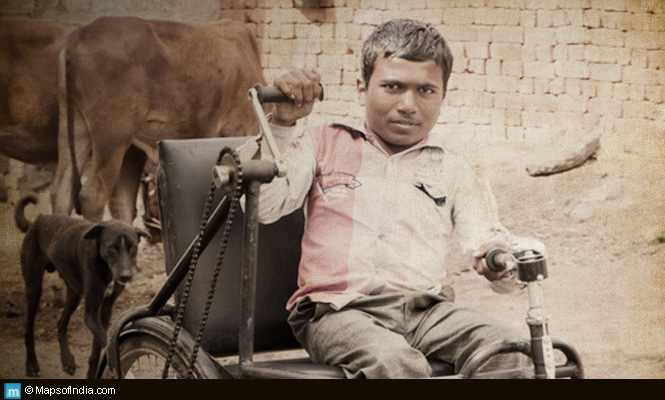
 A disability could be the outcome of an impairment which may be physical, cognitive, mental, sensory, emotional, developmental, or some combination of these, or rarely due to a predominance of special abilities. A disability may be present from birth, or occur during a person's lifetime. However, when one thinks of names like Einstein, Helen Keller, Stephen Hawking, and closer home, names like Sudha Chandran, Arunima Sinha (first amputee to scale the Mount Everest), Rajendra Singh Rahelu (polio-stricken and silver medallist in Commonwealth Games 2014), one realises that these are not just disabled people, they are, in fact, people with very special abilities.
As per the 2011 census conducted in India, disability includes the following physical and cognitive impairments:
A disability could be the outcome of an impairment which may be physical, cognitive, mental, sensory, emotional, developmental, or some combination of these, or rarely due to a predominance of special abilities. A disability may be present from birth, or occur during a person's lifetime. However, when one thinks of names like Einstein, Helen Keller, Stephen Hawking, and closer home, names like Sudha Chandran, Arunima Sinha (first amputee to scale the Mount Everest), Rajendra Singh Rahelu (polio-stricken and silver medallist in Commonwealth Games 2014), one realises that these are not just disabled people, they are, in fact, people with very special abilities.
As per the 2011 census conducted in India, disability includes the following physical and cognitive impairments:
- In seeing
- In hearing
- In speech
- In movement
- Mental retardation
- Mental illness
- Multiple disability
- Others (to include people with disabilities not included in the list.
- Children with disabilities have the right to free education until they reach the age of eighteen in schools that are integrated or in special schools.
- Children with disabilities have the right to appropriate transportation, removal of architectural barriers, as well as the restructuring of curriculum and modifications in the examination system.
- Scholarships, uniforms, books and teaching materials are all provided to children with disabilities for free.
- Children with disabilities have access to special schools that are equipped with vocational training facilities, and non-formal education. India provides training institutions for teachers in order to establish manpower.
- Parents of children with disabilities in the nation can move to an appropriate court for the redress of grievances in regards to their children with disabilities.
- Parents of children with disabilities are required to obtain a 'disability certificate' from 'Office of the Commissioner for Disabilities,' in order to access the facilities.
- Every 'panchayat' is provided funding by the Government in order to build roads, schools and public ramps for people with disabilities.
- Three-percent of all Government jobs in the country are reserved for people with disabilities, and the disability Act includes affirmative action for people with disabilities.
- Respect for inherent dignity, individual autonomy, including the freedom to make one’s own choices, and independence of persons;
- Non-discrimination;
- Full and effective participation and inclusion in society;
- Respect for difference and acceptance of persons with disabilities as part of human diversity and humanity.