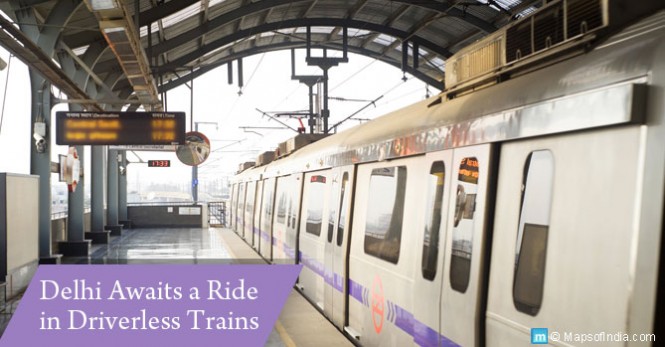
 Though the concept of driverless train is not new in the developed countries, it is still a novel idea in India. In this context, the announcement of Delhi Metro’s first driverless train was a proud moment for India. On 4 June 2015, the first driverless trains arrived in Delhi. These trains will ply on the Phase III corridors covering 58-km long Majlish Park-Shiv Vihar (Line 7) and the over 38-km long Janakpuri (West)- Botanical Garden (Line 8). The trains will be fully operational by the end of 2016.
According to DMRC officials, more than 60 such driverless trains are in the manufacturing process at the Bharat Earth Movers plant in Bengaluru and 20 such trains will be manufactured in South Korea’s Changwan by the end of 2015. These 6-coach trains are equipped with advanced features.
Though the concept of driverless train is not new in the developed countries, it is still a novel idea in India. In this context, the announcement of Delhi Metro’s first driverless train was a proud moment for India. On 4 June 2015, the first driverless trains arrived in Delhi. These trains will ply on the Phase III corridors covering 58-km long Majlish Park-Shiv Vihar (Line 7) and the over 38-km long Janakpuri (West)- Botanical Garden (Line 8). The trains will be fully operational by the end of 2016.
According to DMRC officials, more than 60 such driverless trains are in the manufacturing process at the Bharat Earth Movers plant in Bengaluru and 20 such trains will be manufactured in South Korea’s Changwan by the end of 2015. These 6-coach trains are equipped with advanced features.
How Does the Driverless Train Operate?
The first driverless train that arrived in Delhi in the first week of June will begin service with the help of manual operators or drivers but will be fully operational without drivers by moving to unattended train operation (UTO) by 2016 end. Under the UTO mode, these new trains will be controlled and their movement regulated by the Operations Control Centres (OCC) of the Delhi Metro system and not by manual train operators. Some of the advanced features in these driverless trains are:- These trains are significantly upgraded and eco-friendly.
- These trains can run at a maximum speed of 95 kmph and their operational speed is 85 kmph.
- CCTV cameras are installed for inside and outside view of the train. The CCTV images could be directly accessed by the control centre in driverless mode.
- Dynamic route maps are available in each door panel to let passenger know their journey status.
- While the present metro coaches already have 230V AC charging sockets, the new generation metro trains will have USB slots for mobile charging.
- The capacity of carrying passengers has also been increased in the new trains. Each coach can accommodate a maximum of 380 passengers, which means in the 6-coach train, almost 2,280 passengers can travel.
- The new trains are more energy efficient than the earlier ones with better regeneration of energy during braking.
- There are more energy-efficient subsystems inside the coach such as LED lighting and air conditioning systems.
- Each coach has four 18.5-inch LCD screens continuously displaying audio-visual messages and commercials.
- Fibre reinforced plastic seats have been introduced to add colour.