 It has been rightly said that tourism is the greatest peace movement in the world. Travel and tourism is the largest service sector in India. The income from domestic and foreign tourism contributes more to India’s GDP than the textile sector. An estimated amount of $18.4 billion was earned in foreign exchange through tourism receipts in 2013, with around 7 million tourists from abroad. Domestic travellers amounted to 740 million in the year 2013. It is expected that the tourism sector’s contribution to the country’s GDP will grow at the rate of 7.8 per cent yearly in the period 2013–2023. Apart from contributing to India’s GDP, tourism also helps in the growth of communities and sustainability of the national heritages by generating funds and direct and indirect jobs. Tourism provides 8.78 per cent of the total employment in India.
The Travel & Tourism Competitiveness Report 2013 ranks India 65th out of 144 countries overall. The factors promoting tourism in India are better connectivity, better lodging facilities and the policies and changes implemented by the Government of India to boost the tourism and hospitality industry. The Ministry of Tourism maintains the Incredible India Campaign attracting tourists within the country, and from all over the world.
The National Tourism Day is celebrated every year on the 25th of January; on this day in 1971 Himachal Pradesh, initially a Union territory, became an independent State. This day is celebrated to create awareness among the people of India the importance of tourism, and the ways in which every citizen can contribute towards promoting the same. Some of the ways and means by which every Indian can contribute are maintaining cleanliness, helping preserve the national heritages and maintaining the culture etc.
Different kinds of tourism
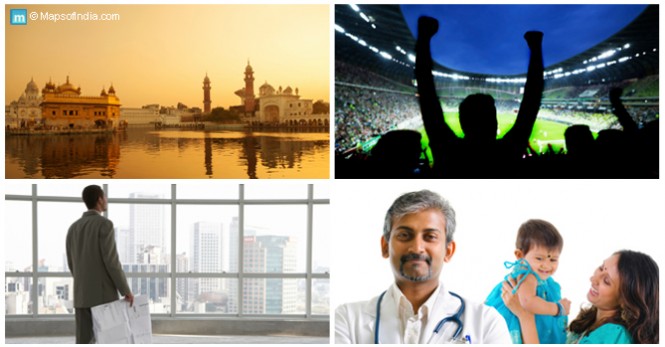
Tourism in India can be categorised into heritage, cultural, business, sports and medical tourism.
It has been rightly said that tourism is the greatest peace movement in the world. Travel and tourism is the largest service sector in India. The income from domestic and foreign tourism contributes more to India’s GDP than the textile sector. An estimated amount of $18.4 billion was earned in foreign exchange through tourism receipts in 2013, with around 7 million tourists from abroad. Domestic travellers amounted to 740 million in the year 2013. It is expected that the tourism sector’s contribution to the country’s GDP will grow at the rate of 7.8 per cent yearly in the period 2013–2023. Apart from contributing to India’s GDP, tourism also helps in the growth of communities and sustainability of the national heritages by generating funds and direct and indirect jobs. Tourism provides 8.78 per cent of the total employment in India.
The Travel & Tourism Competitiveness Report 2013 ranks India 65th out of 144 countries overall. The factors promoting tourism in India are better connectivity, better lodging facilities and the policies and changes implemented by the Government of India to boost the tourism and hospitality industry. The Ministry of Tourism maintains the Incredible India Campaign attracting tourists within the country, and from all over the world.
The National Tourism Day is celebrated every year on the 25th of January; on this day in 1971 Himachal Pradesh, initially a Union territory, became an independent State. This day is celebrated to create awareness among the people of India the importance of tourism, and the ways in which every citizen can contribute towards promoting the same. Some of the ways and means by which every Indian can contribute are maintaining cleanliness, helping preserve the national heritages and maintaining the culture etc.
Different kinds of tourism
Tourism in India can be categorised into heritage, cultural, business, sports and medical tourism.
- Heritage and cultural tourism: India boasts of an approximate of 4,000 years of civilised life. It is a living civilisation with traditions directly arising from the past. Cultural tourism gives a glimpse of the rich past in the present. All tourism in India surely involves a cultural aspect. India is indeed very rich in monumental heritage attracting many foreign tourists with cultural-historical interests. Apart from this India also offers natural heritage, religious heritage, arts and crafts heritage, music heritage and the last but not the least the heritage of gastronomic delights.
- Business tourism: A stable Government, peace and adequate manpower have attracted many global companies to open their branches in India. This has led to an increase in the GDP and generation of employment. In fact, Gujarat known as the “growth engine of India” has seen a double digit GDP in the past decade as a result of business tourism. The booming IT and outsourcing industry is seeing many foreign travellers making business trips, who invariably include a holiday in the trip for sightseeing.
- Sports tourism: Once an alien concept, sports tourism is fast catching on with the Indians, where a holiday with family and friends to watch a sports event in another city is now the order of the day. Events like the Commonwealth Games, IPL, IFL etc have also attracted many foreign tourists to visit India.
- Medical tourism: This term denotes the growing practice of travelling across international borders to obtain health care. India with its state-of-the-art medical facilities, reputed health care professionals, quality nursing facilities and most importantly no waiting period for treatment, is attracting many foreign nationals opting for elective procedures as well as complex specialized surgeries. Financial support as per guidelines and availability of funds under the Market Development Assistance Scheme (MDA) is provided to the approved medical tourism service providers. This category also includes the wellness tourism, wherein foreigners come to India to avail of the most ancient Indian systems of medicines including ayurveda, yoga, panchakarma, rejuvenation therapy, etc. Here the stress is on achieving a sense of well-being and maintaining good health.