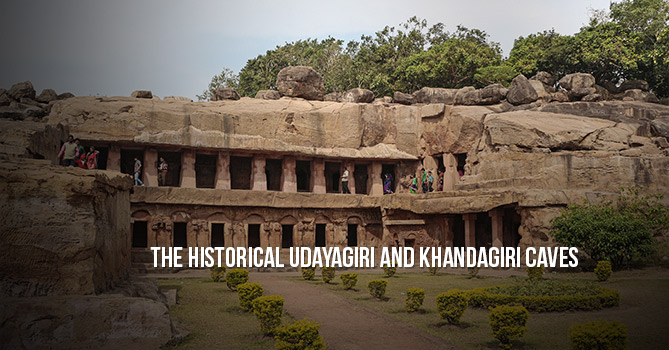
 The hills of Udayagiri and Khandagiri located on the outskirts of Odisha's capital, Bhubaneswar, are historic remnants of India's rich past. The hills house a number of caves, most of which have been carved out by Jain monks and artisans from the times of King Kharavela (of the Mahameghavahana dynasty). Not only are these caves testimony to the architectural genius of ancient India, they also bear messages of love, compassion, and religious tolerance. The Udayagiri and Khandagiri caves are considered among the wonders of India and date back to the first century BC.
Most of the caves are not natural ones but are rock cuts and are believed to have been dwelling cells and meditation quarters for Jain monks of the time. The monks are believed to have lived here under harsh conditions and yet have been able to produce stunning and intricate sculptures depicting the royalty, courts, religious symbols, and ordinary life of society. It is one of the most visited tourist attractions of eastern India.
The two cave complexes are being maintained by the Archaeological Survey of India and are popular tourist spots in Odisha.
Location and Accessibility
The two hills of Udayagiri and Khandagiri are at a distance of about 6 kilometres from Bhubaneshwar city centre. The nearest airport and railway junction is at Bhubaneshwar. From the city private or shared cabs take visitors to the hills. Bhubaneshwar is a state capital and budget and luxury accommodation may be found here.
History
The sandstone caves at Udayagiri and Khandagiri bear testimony to India’s glorious past. Kharavela, during whose time these rock cuts were undertaken, was one of the best-known kings of Kalinga. In 1825, A Stirling, the historian, brought the existence of these caves to public notice and attempted to translate the inscriptions. While it is difficult to obtain an accurate translation due to the disuse of the language – Brahmi, the weathering of the inscriptions, and inaccuracies, what is certain is that these rock edicts declare the respect and the dedication of the king towards all religions and the love his people bore him.
Udayagiri Caves
The name Udayagiri means Hill of Sunrise. There are 18 caves in Udayagiri. The Rani Gumpha or the Queen's Cave is the largest, most majestic cave here. It is a two storied monastery supported by many columns and terraces. The cave contains beautiful sculptures of dancing women, royal entourage, and musical instruments. Other important caves in this hill are the Alkapuri Gumpha, a double storied cave with columns which contains sculptures of elephants and heavenly creatures apart from ornaments and treasures.
The Ganesa Gumpha is one of the rare caves with multiple dwellings and terraces. It is best known for the sculpture of Ganesha that is inscribed on the rear wall of the cave. It also shows a Jain Tirthankara at worship and contains sculptures of elephants. The entrance to the Vyagraha Ghumpa is also noteworthy for its splendid sculpture over the entrance.
The hills of Udayagiri and Khandagiri located on the outskirts of Odisha's capital, Bhubaneswar, are historic remnants of India's rich past. The hills house a number of caves, most of which have been carved out by Jain monks and artisans from the times of King Kharavela (of the Mahameghavahana dynasty). Not only are these caves testimony to the architectural genius of ancient India, they also bear messages of love, compassion, and religious tolerance. The Udayagiri and Khandagiri caves are considered among the wonders of India and date back to the first century BC.
Most of the caves are not natural ones but are rock cuts and are believed to have been dwelling cells and meditation quarters for Jain monks of the time. The monks are believed to have lived here under harsh conditions and yet have been able to produce stunning and intricate sculptures depicting the royalty, courts, religious symbols, and ordinary life of society. It is one of the most visited tourist attractions of eastern India.
The two cave complexes are being maintained by the Archaeological Survey of India and are popular tourist spots in Odisha.
Location and Accessibility
The two hills of Udayagiri and Khandagiri are at a distance of about 6 kilometres from Bhubaneshwar city centre. The nearest airport and railway junction is at Bhubaneshwar. From the city private or shared cabs take visitors to the hills. Bhubaneshwar is a state capital and budget and luxury accommodation may be found here.
History
The sandstone caves at Udayagiri and Khandagiri bear testimony to India’s glorious past. Kharavela, during whose time these rock cuts were undertaken, was one of the best-known kings of Kalinga. In 1825, A Stirling, the historian, brought the existence of these caves to public notice and attempted to translate the inscriptions. While it is difficult to obtain an accurate translation due to the disuse of the language – Brahmi, the weathering of the inscriptions, and inaccuracies, what is certain is that these rock edicts declare the respect and the dedication of the king towards all religions and the love his people bore him.
Udayagiri Caves
The name Udayagiri means Hill of Sunrise. There are 18 caves in Udayagiri. The Rani Gumpha or the Queen's Cave is the largest, most majestic cave here. It is a two storied monastery supported by many columns and terraces. The cave contains beautiful sculptures of dancing women, royal entourage, and musical instruments. Other important caves in this hill are the Alkapuri Gumpha, a double storied cave with columns which contains sculptures of elephants and heavenly creatures apart from ornaments and treasures.
The Ganesa Gumpha is one of the rare caves with multiple dwellings and terraces. It is best known for the sculpture of Ganesha that is inscribed on the rear wall of the cave. It also shows a Jain Tirthankara at worship and contains sculptures of elephants. The entrance to the Vyagraha Ghumpa is also noteworthy for its splendid sculpture over the entrance.
| Names of Caves at Udayagiri | |||
| Cave Number | Cave Name | Cave Number | Cave Name |
| 1 | Rani Gumpha | 10 | Ganesa Gumpha |
| 2 | Bajahara Gumpha | 11 | Jambesvara Gumpha |
| 3 | Chota Hathi Gumpha | 12 | Vyaghra Gumpha |
| 4 | Alkapuri Gumpha | 13 | Sarpa Gumpha |
| 5 | Jaya-vijaya Gumpha | 14 | Hathi Gumpha |
| 6 | Panasa Gumpha | 15 | Dhanaghara Gumpha |
| 7 | Thakurani Gumpha | 16 | Haridasa Gumpha |
| 8 | Patalapuri Gumpha | 17 | Jagammath Gumpha |
| 9 | Mancapuri Gumpha | 18 | Rosai Gumpha |
| Names of Caves at Khandagiri | |||
| Cave Number | Cave Name | Cave Number | Cave Name |
| 1 | Tatowa Gumpha 1 | 9 | Trusula Gumpha |
| 2 | Tatowa Gumpha 2 | 10 | Ambika Gumpha |
| 3 | Ananta Gumpha | 11 | Lalatendukesari Gumpha |
| 4 | Tentuli Gumpha | 12 | Cave Name Unknown |
| 5 | Khandagiri Gumpha | 13 | Cave Name Unknown |
| 6 | Dhyana Gumpha | 14 | Ekadasi Gumpha |
| 7 | Navamuni Gumpha | 15 | Cave Name Unknown |
| 8 | Barabhuji Gumpha | ||