

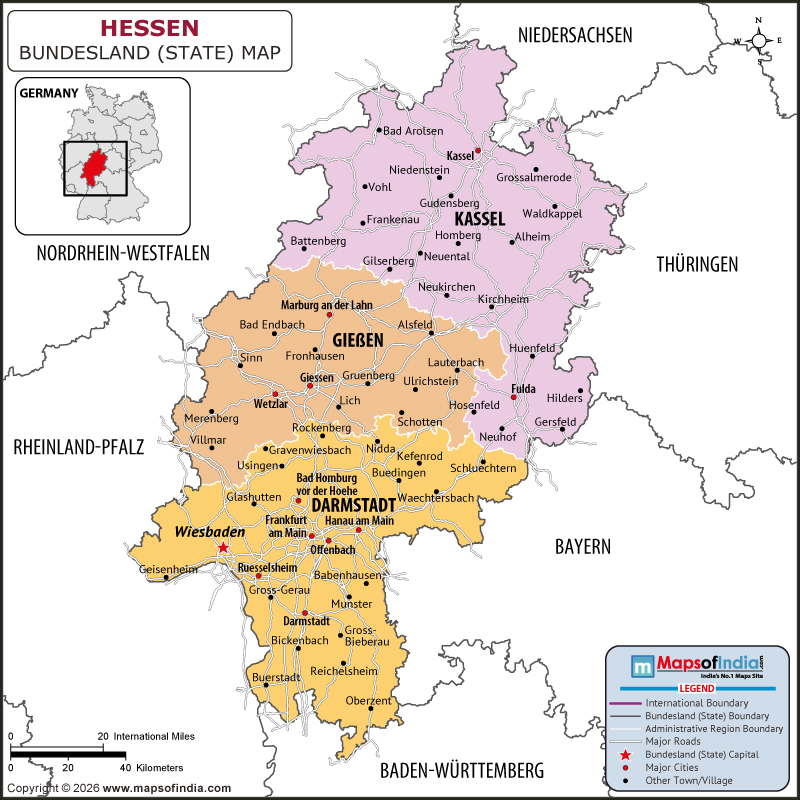



| Country | Germany |
| Region | Hessen |
| Capital | Wiesbaden |
| Area | 21,114.73 km2 (8,152.44 sq mi) |
| Population | 6,243,262 |
Introduction
Hessen is a popular state in west-central Germany. It is full of green forests, some big cities, a few old castles and some villages. A lot of people come to Hessen for its peacefulness, history, and fun. One of the more well-known of them is the city of Frankfurt, one of the world’s key financial and business centres. But Hessen has more to offer beyond Frankfurt.
In this article, we will discuss its history, culture, language, and geography, as well as answer some of the frequently asked questions about this fascinating place.
History
Hessen is rich with history. It lies in the centre of Germany and was influential in the shaping of much of European history. People have been living in this area for thousands of years. The Stone Age people were the first settlers. The area was later settled by Celtic and Germanic peoples.
Some regions of Hessen were occupied and controlled by the Romans. The Romans constructed roads, forts, and trading posts. These facilitated links with other regions for Hessen. Following the collapse of the Roman Empire, various Germanic groups, including the Franks, took control of the area. Hessen was admitted to the Holy Roman Empire in the Early Middle Ages.
The territory was subsequently split into several smaller ones. An important region was the Landgraviate of Hesse. It developed in the 13th century into a powerful local state. A landgrave is a prince with jurisdiction over a country. The Landgraviate of Hesse would form subsequent smaller states such as Hesse-Kassel and Hesse-Darmstadt. Each was led by another branch of the ruling family.
Hessen was one of the first German territories to join the Reformation in the early 16th century. This prompted a lot of change in religion, schools, and day-to-day living. The Hessen population also experienced hard times in the Thirty Years’ War (1618–1648) that brought much devastation and suffering.
Hessen passed through further political changes in the 19th century. Following the Napoleonic Wars, Hessen implemented new political unions. In 1871, the area was incorporated into the German empire. At that time, many people in Hessen worked in farming, crafts, and small factories.
In the 20th century, Hessen was impacted by both World Wars. Numerous cities were hit and people suffered heavy casualties. Hessen was reestablished as a state of the Federal Republic of Germany in 1945. The capital of Hessen, Wiesbaden, once again became a large city after the war.
Hessen has been growing steadily since then. Frankfurt am Main, the largest city in the state, was a major centre for banking, transportation, and trade. Today, Frankfurt is also internationally known and serves as one of Germany's and Europe's major economic hubs.
Today Hessen is a blend of modern cities and a peaceful countryside. Its past is still evident in the castles, old towns and museums of the area. Tourists love to visit historical places and learn about what has happened there and how the area has influenced German history.
Culture
Hessen culture is a nice combination of ancient customs and present day living that culminates in a diverse culture. It's moulded by history and religion, food and festivals, and art. Hessians love their heritage and sharing their traditions with you. Most towns are still very traditional in their living style, while the larger cities present a modern, busy life.
The traditional costume and folk music are one of the most popular aspects of Hessen’s culture. During village gatherings and at festivals, the people would wear old-fashioned clothing called the “Tracht”. Men may have jackets and hats and women may have dresses with aprons. Folk music consists of songs that are accompanied by primitive instruments such as the accordion, flute, and violin. These are happy songs and are frequently heard at public functions.
Hessen is also famed for its festivals. The state has many festivals to commemorate various occasions. One of the best known is the Hessentag, a festival occurring annually in different towns. It features music shows, food stalls and parades. People come here from all over Germany to enjoy it. In a number of other towns and cities smaller fairs are held, where traditional trades and foods are shared.
Food is another thing that is big in Hessen. What people here enjoy are things like simple, tasty food. One popular dish is "Handkäse mit Musik," which entails spreading cheese with onions and vinegar. Another favourite is ‘Grüne Soße’ which is a green sauce using various herbs and typically served with eggs or potatoes. Frankfurt is known for its sausages, and the local beverage of choice is apple wine, or “Apfelwein,” which residents enjoy most frequently in pubs called “Apfelweinkneipen,”.
Frankfurt, Wiesbaden and Kassel are known for their museums, galleries and theatres. The city of Kassel features one of the largest modern art shows in the world, the “Documenta,” which takes place every five years.
Hessen is also full of legends and fairy tales. The Brothers Grimm, who gathered many famous fairy tales, were from this area. Their stories, such as “Hansel and Gretel” or “Snow White,” continue to be loved by kids and adults. Many places throughout Hessen are associated with these stories and attract tourists.
Life in Hessen is balanced. They work hard but also spend time with family, in nature and at dinner parties. The area has numerous parks, forests and hiking trails, so outdoor life is part of the culture. Neighbours bump into one another at markets or cafés and exchange friendly conversations.
In summary, the culture of Hessenian’s is friendly, warm and diverse. It links past and present organically. Through food, festivals, music and art, Hessen provides a real taste of German tradition with a modern touch.
Language
The native language of Hessen is German. You will hear the high German in schools, offices, shops, and throughout public places. Most people speak it clearly and slowly, which is helpful for those who are visiting and learning the language.
Some of the older inhabitants of the small towns and villages still speak Hessisch, a local dialect. It has different sounds and words, but young people don’t use it very much. And yet, it’s integral to the character of the state.
English is often seen, especially in large cities such as Frankfurt and Wiesbaden. A good number of people in restaurants, hotels and resorts understand and speak English. You can always get help if you know simple English. Hessen is a visitor-friendly region. Language should not be a major barrier for most visitors.
Geography
Hessen is a beautiful region in the heart of Germany. It is bordered by many of the other German states, including North Rhine-Westphalia, Bavaria, Lower Saxony, Thuringia, Baden-Württemberg and Rhineland-Palatinate. Because of its central position, Hessen is frequently referred to as the “heart of Germany.” This position allows easy transit connecting Hessen with the rest of the country.
Hessen has an incredibly diverse geography. It contains hills, forests, rivers, valleys and at least a few mountains. The Taunus is the most prominent natural region in Hessen. These are not very high mountains, but they are lush and serene. The beauty of an area near the Chusovaya River draws many hikers and nature-lovers. Other regions include the Rhön Mountains and the Westerwald, where you can also enjoy lush open views and clean air.
One of the best-known forested regions is the Kellerwald-Edersee National Park. It is covered with tall trees, all kinds of wild animals and walking paths. This park is a world heritage site by UNESCO. Families in the area take school trips and holidays there.
There are also numerous rivers within the state. The Rhine river acts as Hessen's western border. It is among the most significant rivers of Europe. Another important river is the Main river, which flows through Frankfurt. Trade and transport are some of the other important uses of rivers.
The land in Hessen is generally soft hilly land with wide valleys. These are fertile valleys, and it is possible to farm on them. Farmers cultivate potatoes, wheat, corn and other crops. Vineyards can also be spotted in a few places along the rivers, especially near wineries. Fruit-growing, particularly the raising of apples for the production of apple wine, is frequent in Hessen.
Hessen is home to small villages and big cities. The largest city is Frankfurt am Main, a centrally important hub of finance, transport and industry. Wiesbaden, Kassel, Darmstadt, and Gießen are other important cities. These places are all connected by roads and trains, and in each city, it’s possible to find a balance of nature and urban life.
The climate in Hessen is mild. Summers are warm without being too hot, and winters are cold without becoming too extreme. There is rain all year, which keeps the land green. There may be snow in winter, even in the low lying area of the Taunus mountains.
You can find something for everyone in Hessen like green forests, rolling hills, peaceful rivers, and vibrant cities. If someone loves hiking or farming, city life or peaceful villages, Hessen is a great place for them.
| Category | Details |
|---|---|
| Country | Germany |
| Region | Hessen |
| Capital | Wiesbaden |
| Area | 21,114.73 km2 (8,152.44 sq mi) |
| Population | 62,43,262 |
FAQs
Q.1: Where is Hessen located in Germany?
Hessen is situated in the middle of Germany. It shares a border with six other German states and is sometimes referred to as the “heart of Germany” due to its location in the centre of the country.
Q.2: What is Hessen known for?
Hessen is known for its green forests, hilly landscapes, spa towns and the financial centre Frankfurt. It is also known for the locally produced food and apple wine.
Q.3: What are some famous places in Hessen?
Some well-known destinations within Hessen are Frankfurt, Wiesbaden, Kassel, the Taunus hills, Kellerwald-Edersee National Park and Wartburg Castle.
Last Updated on: June 22, 2026

