Paithani Saree Background
-
Ancient Origins
-
Trade's Impact and Dynasties
Contemporary Reviving
Early 20th-century industrialisation and the flood of power threatened the survival of traditional Paithani weaving. However, a rebirth has resulted from increased interest in handloom textiles, government projects, and the commitment of artisan families. Paithani sarees today are identified with a Geographical Indication (GI) tag, safeguarding their authenticity and advancing weaver welfare.Methods of Weaving
-
Materials Used
The Craft of Weaving
Making a Paithani saree takes time and effort; often, one piece takes several months to finish. The procedure comprises several phases:1. Dyeing the silk
Natural or synthetic dyes are used to vividly colour the silk yarns. The colours chosen are essential since traditional Paithani sarees are renowned for their unique hues, including peacock green, magenta, purple, and sky blue.2. Loom preparation
Carefully laid on a conventional handloom, the dyed silk threads The wanted design guides the arrangement of the warp (vertical threads) and weft (horizontal threads).3. Motif Designing
Celebrated for their intricate designs, which are either memorised by master weavers or drawn on graph paper, are paithani sarees. A common motif is the Peacock (Mor), which stands for grace and beauty. Lotus (Kamala): Stressing innocence. Tota or parrot: stands for fertility and love. Narayani: paints geometric designs and floral vines. Ajanta Lotus : Inspired by the Ajanta Caves' frescoes.4. Wearing a tapestry
Paithani weaving is distinguished by its tapestry method, which lets one create complex, reversible designs. There are three primary methods: Split Tapestry Weave: Two weft threads are reversed and woven into nearby warp threads to create sharp colour changes. Interlocking Weave (Kadiyal): Two weaves are interlocked at the colour junctions to create almost identical motifs on both sides. Single Shuttle (Ekdhoti): The weft is made from a single shuttle (Ekdhoti), producing a flawless, seamless finish. Often using separate shuttles for each colour in the motif, the weaver painstakingly interlaces the zari with the silk. After such a laborious process, it promises clearly defined sharpness and vividness in the motifs.5. Completion
Finally, the saree is washed, starched, and buffed to a high sheen. The final result is a royal or luxurious cloth, lustrous and warmly textured but intricately designed.Differentiating Characteristics
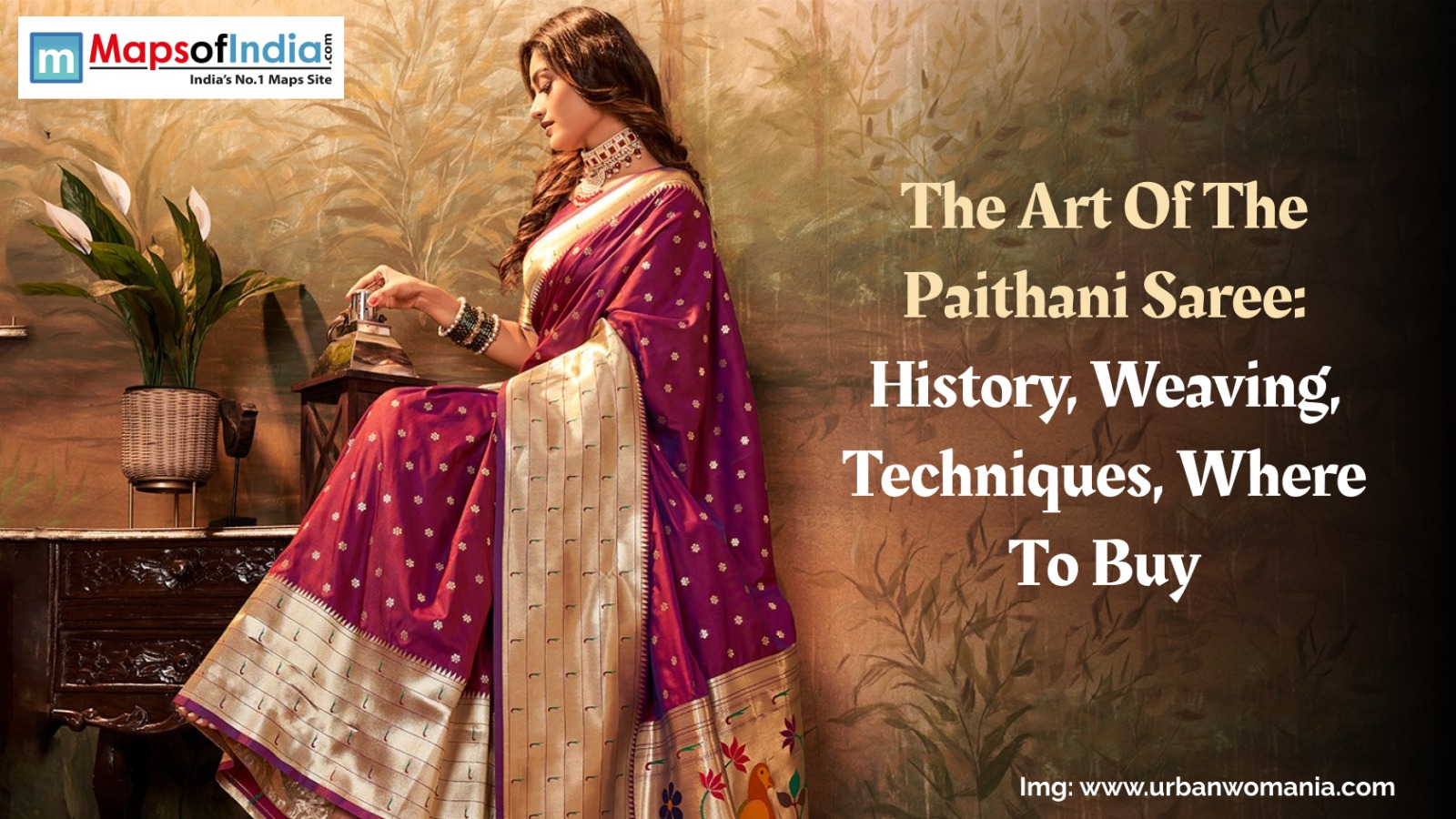
Reversible Borders and Pallu: One special aspect of real Paithani is the identical motifs and borders of the saree on both sides. Oblique Square Borders: Known as "Narali," these classic Paithani sarees feature oblique square borders. Kaleidoscopic Effect: Using different colours for the warp and weft produces a dual-tone look using a kaleidoscopic effect.Types of Paithani Sarees
Various Motifs and Border Inspired Designs
Yeola Paithani: Made in Yeola, Nashik, noted for vivid colours and symmetrical patterns. Maharani Paithani: Features complex, non-identical pallus inspired by Indian mythology motifs. Peshwai Paithani: Features geometric bhuttas, floral designs, and pink-gold borders.Based on Colour
Bangadi Mor: Green body with peacock-inspired designs. Shirodak: White body with vibrantly coloured borders. Kalichandrakala: Red-border jet black saree.Contemporary Adaptations
Modern weavers have combined traditional Paithani with other regional weaving techniques to create variants, including Kota Paithani, Gadwal Paithani, and Himroo Paithani.Identifying an authentic Paithani saree
Important Metrics
Material: Made from real zari threads and pure silk, materials Reversible Motifs: Designs are visible and the same on both sides; there are no loose threads at the rear. Craftsmanship: Handwoven intricately patterned with a lustrous finish. Geographical Indication (GI) Tag: Authentic Paithani sarees are registered under a GI tag, which certifies their source.Typical Imitations
Though they copy Paithani designs, machine-made or power-loom sarees lack the elegance, durability, and distinctive qualities of handwoven originals. Consumers should check the source and search for GI certification or Silk Mark.Where to Purchase Paithani Sarees
Physical Retail Stores
Yeola, Nashik: Real Paithani sarees are mostly found here. Local showrooms and weavers offer a wide spectrum of designs, and visitors can watch the weaving process. Paithani Silk Weaving Centre, Aurangabad: Offering authentic Paithani sarees and insights into the ancient weaving techniques. Government Emporiums: Certified Paithani sarees come from Maharashtra State Handloom Corporation and Central Cottage Industries Emporium.Cost Range
These gorgeous silk sarees cost at least 10,000 INR, but they can cost up to 200,000 INR, depending on the intricate designs, the quality of silk, and the zari work used.Conservation and Attention
To preserve the grace and lifetime of a Paithani saree:- Store muslin cloth wrapped in a calm, dry environment.
- Cleaning: Dry only; stay away from house washing to help preserve the zari.
- Refold sometimes to avoid creases and zari damage.