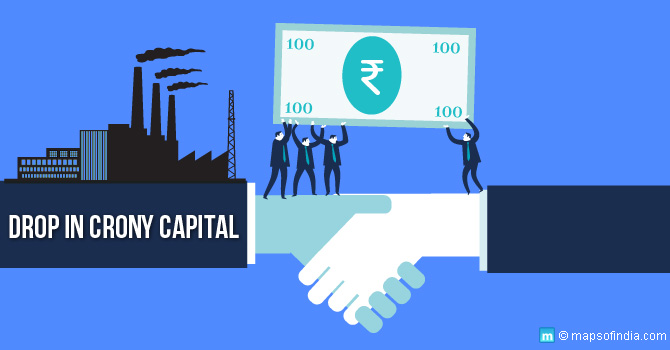
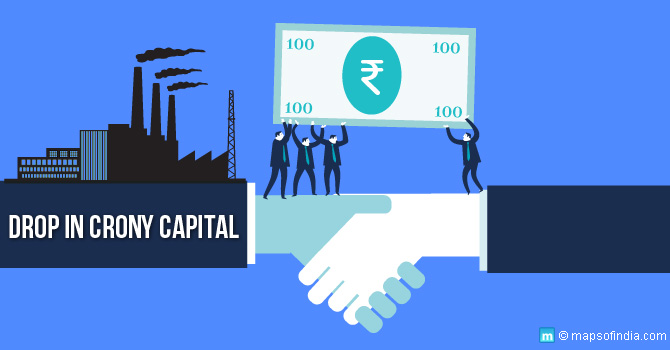
 The term ‘crony capitalism’ grew out of flaws in a capitalist economy where a few well-connected individuals benefitted immensely due to their connections and affiliations with those in power.
These ‘crony capitalists’ flourished through unfair advantage given to them in core industries like mining, infrastructure, construction, energy, telecom, defence, etc.
In an attempt to map crony capitalism worldwide, The Economist magazine came out with ‘Crony Capitalism Index’ that uses data derived from IMF, Forbes and other popular sources, to monitor how crony-specific sectors and non-crony sectors contributed to wealth creation of certain select billionaires, as a percentage of the GDP.
The term ‘crony capitalism’ grew out of flaws in a capitalist economy where a few well-connected individuals benefitted immensely due to their connections and affiliations with those in power.
These ‘crony capitalists’ flourished through unfair advantage given to them in core industries like mining, infrastructure, construction, energy, telecom, defence, etc.
In an attempt to map crony capitalism worldwide, The Economist magazine came out with ‘Crony Capitalism Index’ that uses data derived from IMF, Forbes and other popular sources, to monitor how crony-specific sectors and non-crony sectors contributed to wealth creation of certain select billionaires, as a percentage of the GDP.
The term ‘crony capitalism’ grew out of flaws in a capitalist economy where a few well-connected individuals benefitted immensely due to their connections and affiliations with those in power.
These ‘crony capitalists’ flourished through unfair advantage given to them in core industries like mining, infrastructure, construction, energy, telecom, defence, etc.
In an attempt to map crony capitalism worldwide, The Economist magazine came out with ‘Crony Capitalism Index’ that uses data derived from IMF, Forbes and other popular sources, to monitor how crony-specific sectors and non-crony sectors contributed to wealth creation of certain select billionaires, as a percentage of the GDP.
The term ‘crony capitalism’ grew out of flaws in a capitalist economy where a few well-connected individuals benefitted immensely due to their connections and affiliations with those in power.
These ‘crony capitalists’ flourished through unfair advantage given to them in core industries like mining, infrastructure, construction, energy, telecom, defence, etc.
In an attempt to map crony capitalism worldwide, The Economist magazine came out with ‘Crony Capitalism Index’ that uses data derived from IMF, Forbes and other popular sources, to monitor how crony-specific sectors and non-crony sectors contributed to wealth creation of certain select billionaires, as a percentage of the GDP.