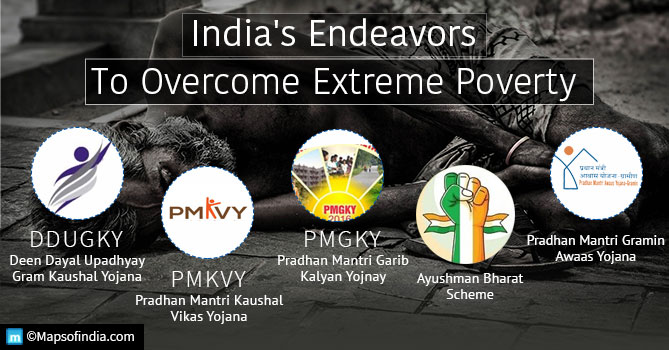
 India is the fastest-growing economy in the world today, but extreme poverty remains a roadblock in India’s path of becoming an economic superpower. However, the government has been working actively towards eradicating this gross reality from society.
After years of concerted efforts, India finally has shed the title of being home to the largest number of people living in extreme poverty in the world and was overtaken by Nigeria in May this year. With 44 Indians coming out of the clutches of extreme poverty every minute, India has become the country which is growing at the fastest rate in terms of poverty reduction in the world. If the present trend continues, India will make it to the third position by the end of 2018, with the Democratic Republic of the Congo taking the second spot. A recent study states that by 2022, not more than 3% of Indians will be poor and extreme poverty could be eliminated by 2030.
India is the fastest-growing economy in the world today, but extreme poverty remains a roadblock in India’s path of becoming an economic superpower. However, the government has been working actively towards eradicating this gross reality from society.
After years of concerted efforts, India finally has shed the title of being home to the largest number of people living in extreme poverty in the world and was overtaken by Nigeria in May this year. With 44 Indians coming out of the clutches of extreme poverty every minute, India has become the country which is growing at the fastest rate in terms of poverty reduction in the world. If the present trend continues, India will make it to the third position by the end of 2018, with the Democratic Republic of the Congo taking the second spot. A recent study states that by 2022, not more than 3% of Indians will be poor and extreme poverty could be eliminated by 2030.
What is Extreme Poverty all about?
Extreme poverty is defined as an individual living on less than $1.9 a day. It is an unusual and complex condition in which an individual does not have any source of income or have an insufficient amount of income to meet his basic needs over some time. The concept of extreme poverty is not only about a lack of money or material resources, but it also deals with the lack of opportunities among individuals to make choices for their sustainable living.What has led to Extreme Poverty?
Extreme poverty is a condition that has not developed on its own. There have been causes which have been responsible for the rise of this condition in the society. Some economists suggest that it is the poor who are responsible for the increase of this condition as they have little or no concern for their future. In contrast, others say that the poor have become fatalists and resigned themselves to a culture of poverty in which nothing can be done to change their economic conditions. So here are some causes which led to the condition of extreme poverty in India:- 1. Lack of Education: Education plays an essential role in making a person financially viable. But the poor, due to lack of resources, cannot afford to send their children to schools. Some poor consider education as frivolous. They prefer to send their children to work and contribute to the family’s income rather than going to schools. 2. Over Population: The increasing population of the country is the primary cause of extreme poverty. It has outpaced the economic growth of the country resulting in no change in the situation of poverty. The size of the families is getting bigger, which reduces the per capita income leading to lower standards of living. 3. Unemployment: The illiteracy among the poor is a significant cause of unemployment among the poorest sections of the society which stops them from getting better-paying jobs. 4. Corruption: Even though the government is making a lot of efforts to improve the conditions of the poor caught under the clutches of extreme poverty, only a small percentage reaches the beneficiaries due to prevalent corruption and the red-tapism in the country. 5. Absence of basic amenities: The poor are deprived of basic facilities which any person requires for his sustenance. Lack of financial resources stops them from fulfilling their basic human needs. 6. Harsh climate: The tropical climate of India throughout the year makes it difficult for the labour class to work. This results in lowering of the productivity and the wages of the workers. 7. Discrimination and social inequality: A wide disparity is prevalent in society when it comes to the distribution of assets like land, wealth, etc. among the rich and the poor. The poor are deprived of all the basic necessities while upper and middle-income groups are witnessing an increase in their earnings. 8. Lack of skilled labour: There is labour in the country, but skilled labour is in smaller number. Although several vocational training initiatives have been launched by the government to train the unskilled labour force, there are still some sections of the poor that are unaware and need to be provided with the benefit of these schemes. Many of these causes are aggravated by poverty and created a cycle of suffering that averts India’s most-needy people from having essential health services, resources, and information that they need to survive.Consequences of Extreme Poverty
Extreme poverty is not only a quelling condition, but it is also one of the world’s biggest problems. The effects of poverty are severe. Some of the consequences are:-- Obstruction in the economic growth and development of the country
- High infant mortality rate due to inadequate medical facilities
- Fewer children are enrolled in schools as parents cannot afford their education
- Infants with low birth weight suffer from mental and physical disabilities
- Unemployment and extreme poverty leads to domestic violence
- Stress among the family members
- Malnutrition
- Increase in hygiene and diet-related diseases
- Increased rate of homeless people
- Terrorism
- Genocide