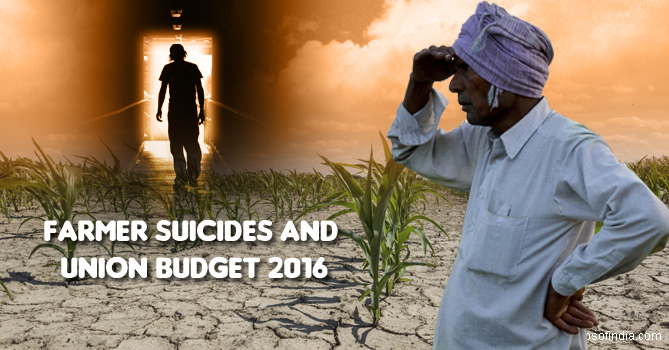
 India has a serious problem. Indian farmers are continuing to take their own lives as monsoon failed in certain parts of India for the second straight year in a row. Parts of Maharashtra, A.P, Telangana and Odisha, have been severely affected on account of poor monsoon and this has led to a continuing spate in farmer suicides.
Prime causes of farmer distress
While monsoon failure tops the list, lack of state investment in water conservation and management has only added to the problem. Adding to this has been lack of soil health management and monitoring, improper seed selection and timely distribution, lack of adequate crop insurance, and timely disbursal of insurance relief, have all contributed to the overall distress faced by farmers.
Population is continuing to grow at a rapid pace and demand for food is putting added pressure on agricultural production. However, growth in agriculture is not keeping pace with population growth and this in turn is increasing financial stress on farmers. The gap between the amount paid to the farmer and the retail price paid by the end user only indicates the imbalance in our agricultural production and distribution system.
Recent example of onion and pulse shortage in the market saw retail prices of both shoot up significantly. In both cases, the shortage was artificially created by large wholesalers and certain large farmers, who hoarded the stock for release at a subsequent date when the demand would be high.
While these people earned enormous profits, the farmers got the lowest possible compensation. In other words, farmers continued to remain at the distressed levels, while others profited. This is a perfect example of mismanagement of the distribution system, where benefits to the farmer are minimal, and yet, end users are paying a significantly higher price.
Record farmer suicides in Maharashtra
Maharashtra can lay claim to many records that point to positive achievement, but it also has the dubious distinction of witnessing 3,228 farmers committing suicide in 2015, the highest since 2001.
The highest number of suicides were reported from Aurangabad - 1,130, Amravati - 1,179, Nashik - 459, Nagpur - 362, Pune - 96, Konkan - 2.
As per Radha Mohan Singh, Union Agriculture Minister, Maharashtra government has responded by identifying 1,841 cases of the 3,228 farmers who committed suicide, as being eligible for ex-gratia payments, 903 cases were classified as ineligible and 484 cases were still under enquiry process. The minister stated that Rs 1 lakh had been paid as immediate relief to 1,818 families of farmers that committed suicide.
Preventive measures undertaken by the state government
On its part, the centre has released Rs 3,049.36 crore to Maharashtra as an immediate relief measure to launch several schemes in the short and medium term to address the problem of drought.
The state government, on its part, has aggressively pushed to implement the Baliraj Chetna Abhiyan Scheme, under which the local District Collector heads a district level committee with a budget allocation of Rs 10 crore to be spent on reducing the distress levels of farmers through counseling, reviving the social support system, health counseling, de-addiction measures and improving awareness of various measures available from the government.
At the village level, the local sarpanch has Rs 1 lakh annually available to him which he can disburse funds to provide interim relief to farmers in distress. These funds also cover areas like emergency funds for health or education purposes.
But has the FY’16-17 Budget made adequate provision to resolve farmer suicides?
The central government is fully apprised of the critical situation that farmers are facing and the FY’16-17 budget has announced several measures that will impact and provide relief to farmers in the short, medium and long term. The big question is - are these enough?
Let’s take a look at some major announcements for the agricultural sector.
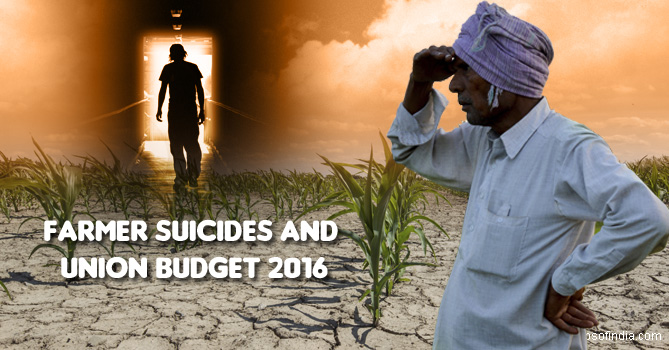
India has a serious problem. Indian farmers are continuing to take their own lives as monsoon failed in certain parts of India for the second straight year in a row. Parts of Maharashtra, A.P, Telangana and Odisha, have been severely affected on account of poor monsoon and this has led to a continuing spate in farmer suicides.
Prime causes of farmer distress
While monsoon failure tops the list, lack of state investment in water conservation and management has only added to the problem. Adding to this has been lack of soil health management and monitoring, improper seed selection and timely distribution, lack of adequate crop insurance, and timely disbursal of insurance relief, have all contributed to the overall distress faced by farmers.
Population is continuing to grow at a rapid pace and demand for food is putting added pressure on agricultural production. However, growth in agriculture is not keeping pace with population growth and this in turn is increasing financial stress on farmers. The gap between the amount paid to the farmer and the retail price paid by the end user only indicates the imbalance in our agricultural production and distribution system.
Recent example of onion and pulse shortage in the market saw retail prices of both shoot up significantly. In both cases, the shortage was artificially created by large wholesalers and certain large farmers, who hoarded the stock for release at a subsequent date when the demand would be high.
While these people earned enormous profits, the farmers got the lowest possible compensation. In other words, farmers continued to remain at the distressed levels, while others profited. This is a perfect example of mismanagement of the distribution system, where benefits to the farmer are minimal, and yet, end users are paying a significantly higher price.
Record farmer suicides in Maharashtra
Maharashtra can lay claim to many records that point to positive achievement, but it also has the dubious distinction of witnessing 3,228 farmers committing suicide in 2015, the highest since 2001.
The highest number of suicides were reported from Aurangabad - 1,130, Amravati - 1,179, Nashik - 459, Nagpur - 362, Pune - 96, Konkan - 2.
As per Radha Mohan Singh, Union Agriculture Minister, Maharashtra government has responded by identifying 1,841 cases of the 3,228 farmers who committed suicide, as being eligible for ex-gratia payments, 903 cases were classified as ineligible and 484 cases were still under enquiry process. The minister stated that Rs 1 lakh had been paid as immediate relief to 1,818 families of farmers that committed suicide.
Preventive measures undertaken by the state government
On its part, the centre has released Rs 3,049.36 crore to Maharashtra as an immediate relief measure to launch several schemes in the short and medium term to address the problem of drought.
The state government, on its part, has aggressively pushed to implement the Baliraj Chetna Abhiyan Scheme, under which the local District Collector heads a district level committee with a budget allocation of Rs 10 crore to be spent on reducing the distress levels of farmers through counseling, reviving the social support system, health counseling, de-addiction measures and improving awareness of various measures available from the government.
At the village level, the local sarpanch has Rs 1 lakh annually available to him which he can disburse funds to provide interim relief to farmers in distress. These funds also cover areas like emergency funds for health or education purposes.
But has the FY’16-17 Budget made adequate provision to resolve farmer suicides?
The central government is fully apprised of the critical situation that farmers are facing and the FY’16-17 budget has announced several measures that will impact and provide relief to farmers in the short, medium and long term. The big question is - are these enough?
Let’s take a look at some major announcements for the agricultural sector.
- Rs 35,984 crore allocated for agriculture and farmer’s welfare.
- The Finance Minister underlined the government’s resolve to increase its focus on ‘Pradhan Mantri Fasal Bima Yojana’ with an allocation of Rs 5,500 crore.
- To ease the burden of farmer loan repayment, Rs 15,000 crore has been provided for towards interest subvention.
- Irrigation projects to be taken up in mission mode. 28.5 lakh hectares to be brought under the irrigation plan.
- 89 long delayed irrigation projects under AIBP to be put under fast track.
- A special ‘Long Term Irrigation Fund’ with a corpus of Rs 20,000 crore will be created under NABARD.
- Rs 6,000 crore to be spent through multilateral funding on sustainable management of ground water resources.
- Under MNREGA, 5 lakh farm ponds and dug wells will be taken up in rain fed areas. In addition, 10 lakh compost pits will be set up to increase production and use of organic manure.
- 14 crore farm holdings will be covered this year under the ‘Soil Health Card’ Scheme.
- Rs 850 crore has been allocated for setting up four new dairy projects to promote development of indigenous cattle breeds.
2016 Budget Session of Parliament
Key Expectations from Union Budget 2016-17
Railway Budget 2016 – An Analysis
Expectations from Rail Budget 2016
Budget 2016: Change on the cards?
Top 50 Takeaways From Union Budget 2015-16