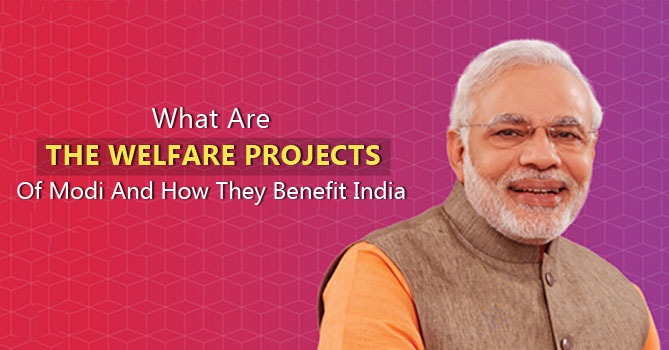
 Here is a detailed analysis of the welfare projects undertaken by Modi government and how India benefited from them.[/caption]
The I&B Minister Prakash Javadekar has asked all ministries to initiate media campaigns beginning Feb 15, highlighting the achievements of the welfare programs undertaken by their respective ministries in the Modi government.
The Delhi poll debacle has prompted the BJP high command to do introspection on the factors leading to defeat. One of the takeaways is poor communication of the benefits of the welfare projects undertaken by the government across the country, and the central government wishes to take corrective measures.
Here is a detailed analysis of the welfare projects undertaken by Modi government and how India benefited from them.[/caption]
The I&B Minister Prakash Javadekar has asked all ministries to initiate media campaigns beginning Feb 15, highlighting the achievements of the welfare programs undertaken by their respective ministries in the Modi government.
The Delhi poll debacle has prompted the BJP high command to do introspection on the factors leading to defeat. One of the takeaways is poor communication of the benefits of the welfare projects undertaken by the government across the country, and the central government wishes to take corrective measures.
Here are some welfare works of the Modi government likely to be highlighted in the upcoming campaigns.
~ Beti Bachao Beti Padhao (BBBP) ~ JAM: Just Achieving Maximum ~ UDAY: Bringing light to where it matters ~ Jan Dhan Yojana ~ UDAY If one looks beyond the political cacophony in Parliament and television studios, there are some very good government initiatives delivering excellent welfare benefits to various sections of society. Too much focus is on GDP and PMI numbers as a measure of what’s happening in the economy. However, going beyond these parameters, there is a silent revolution taking shape where people’s lives are changing for the better. It’s time to look at some of these welfare initiatives. All governments are well-intentioned; it’s the execution and monitoring of programs that often differentiates the quality and level of benefits received by the beneficiary. Nine months into the second term of PM Modi, it is a good time to see how various welfare programs are shaping up and how the people perceive its benefits. Beti Bachao Beti Padhao (BBBP) The Girl Child is finally beginning to find her place in society. Mindsets take time to change; BBBP has accelerated that process, and the results are showing. A pet project of the Prime Minister, BBBP initiative was launched in 2015, aimed at saving, celebrating, and developing the girl child. In scale and benefits, the results are indeed impressive.Initially, the program targeted 100 districts, later extended to 160. Driven by the success achieved, the program extended across all 640 districts in March 2018.Saving the girl child is a priority, and the results are showing. Take the case of 80 villages of Kapurthala district of Punjab, where the Child Sex Ratio was declining. The program saw 60 of 80 villages improve the Child Sex Ratio, a major achievement in a deeply patriarchal society. Similar results reported from Rewa in Madhya Pradesh. The program created awareness among women to avoid prenatal sex determination tests and educated on the benefits of raising a girl child. The program commenced in January 2016, and today, 8,550 happy mothers are busy nurturing their girl child. The success stories extend across the country.
JAM: Just Achieving Maximum
JAM aimed at achieving:- Maximum values for every Rupee
- Maximum empowerment for the poor
- Maximum technology for the masses
|
|
|
|
|
UDAY: Bringing light to where it matters
Living in urban areas, we take electricity, fans and ACs for granted with the flick of a switch. Ask our rural counterpart what it means to get any electricity at all, leave alone luxuries like fans and ACs. In early 2014, the power generation situation was grim. Sixty-six per cent of power generating units held coal stocks of just seven days. Rural areas were starved of electricity through the heat of summer and the freeze of winter, depending on which part of the country they lived. Today, the rural electrification program has brought light into the lives of the neglected, improving lives in more ways than we can imagine living in the comforts of our urban homes. Making electricity available was one challenge; making it affordable was another beast altogether. The UDAY scheme has changed that and the numbers speak for themselves. Over 30 states agreed to join the UDAY initiative; take a look at the beneficiaries: Over 100 per cent rural households which were unconnected now have electricity. In March 2016, 1564.1 lakh households had access to electricity; March 2020, 1989.03 lakh households have electricity. Some of the best performing states, from target to achievement, as on Sept 2019 were:- Madhya Pradesh: Pre-UDAY Household – 15.21 lakh; Post-UDAY households – 31.21 lakh households
- Maharashtra: Pre-UDAY Households – 9.49 lakh; Post-UDAY households – 32.8 lakh households
- Assam: Pre-UDAY Households – Zero households; Post-UDAY households – 26.37 lakh households
- Telangana: Pre-UDAY Households – 6.05 lakh; Post-UDAY households – 11.0 lakh households
- Assam: Pre-UDAY – Zero bulbs; Post-UDAY – 56.95 lakh bulbs
- Maharashtra: Pre-UDAY – 83 lakh bulbs; Post-UDAY – 102.18 lakh bulbs
- Telangana: Pre-UDAY – 12.43 lakh bulbs; Post-UDAY – 17.72 lakh bulbs
- Himachal Pradesh: Pre-UDAY – 20 lakh bulbs; Post-UDAY – 27.15 lakh bulbs
- Tamil Nadu: Pre-UDAY – 32.20 lakh bulbs; Post-UDAY – 33.21 lakh bulbs