 Making India a Global Hub for E-vehicle Manufacturing[/caption]
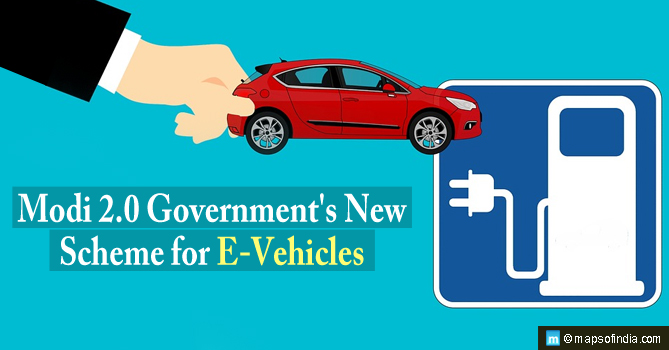
Modi 2.0 government seems to be intent upon going green by promoting electric vehicles in its Union Budget 2019-20. While presenting her maiden budget in the Parliament on July 5, 2019, Minister of Finance and Corporate Affairs, Nirmala Sitharaman, outlined multifarious proposals to make India a global hub for e-vehicle manufacturing, and at the same time incentivize their adoption.
Sitharaman said that under Phase-II of the FAME (Faster Adoption and Manufacturing of Hybrid & Electric Vehicles) Scheme, incentive will be provided to the advanced batteries as well as registered e-vehicles only. She underscored that greater emphasis will be provided on e-vehicles, so that common people can get affordable and environment-friendly public transport.
The new scheme also encourages faster adoption of e-vehicles by:
- Providing upfront incentive on the purchase of these vehicles
- Establishing the necessary charging infrastructure
FAME (Phase-II) Scheme has an outlay of Rs. 10,000 crore for a 3-year period, following the cabinet approval, and has already started from April 1, 2019.
The Finance Minister went on to say that e-vehicle manufacturing will get a major boost after the inclusion of solar storage batteries and charging infrastructure in the FAME (Phase-II) Scheme. She stressed on the fact that this will help India leapfrog and ultimately become a global hub in e-vehicle manufacturing.
Nirmala Sitharaman said that Modi government has already moved GST council for lowering the GST rate in e-vehicles from the existing 12% to 5%.
To boost consumer demand for electric vehicles (EVs), the Union Budget 2019-20 announced providing additional income tax deduction of Rs 1.5 lakh on the interest paid by the customer on auto loans for purchasing e-vehicles. Reports say that the taxpayers who take auto loans for purchasing EVs will get a total benefit of around Rs 2.5 lakhs over the loan period. For incentivizing e-mobility, Modi 2.0 government has also exempted customs duty on certain automobile parts of electric vehicles.
Minister of Finance and Corporate Affairs Minister Nirmala Sitharaman’s announcement of the incentive schemes for both the manufacturers and consumers of e-vehicles comes at a time when Niti Aayog has proposed a ban on all 2-wheelers and 3-wheelers having internal combustion engine under 150cc and migrate to full e-vehicles by 2023 and 2025 respectively.
Making India a Global Hub for E-vehicle Manufacturing[/caption]
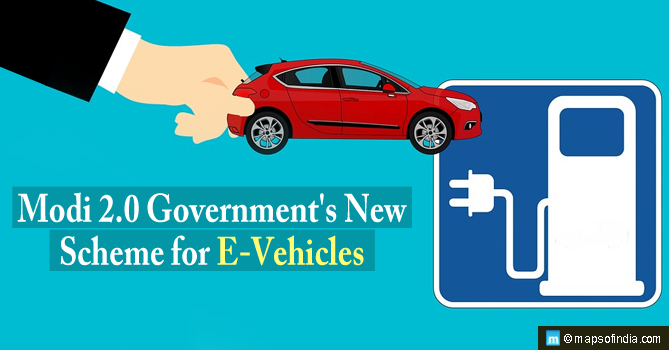
Modi 2.0 government seems to be intent upon going green by promoting electric vehicles in its Union Budget 2019-20. While presenting her maiden budget in the Parliament on July 5, 2019, Minister of Finance and Corporate Affairs, Nirmala Sitharaman, outlined multifarious proposals to make India a global hub for e-vehicle manufacturing, and at the same time incentivize their adoption.
Sitharaman said that under Phase-II of the FAME (Faster Adoption and Manufacturing of Hybrid & Electric Vehicles) Scheme, incentive will be provided to the advanced batteries as well as registered e-vehicles only. She underscored that greater emphasis will be provided on e-vehicles, so that common people can get affordable and environment-friendly public transport.
The new scheme also encourages faster adoption of e-vehicles by:
- Providing upfront incentive on the purchase of these vehicles
- Establishing the necessary charging infrastructure
FAME (Phase-II) Scheme has an outlay of Rs. 10,000 crore for a 3-year period, following the cabinet approval, and has already started from April 1, 2019.
The Finance Minister went on to say that e-vehicle manufacturing will get a major boost after the inclusion of solar storage batteries and charging infrastructure in the FAME (Phase-II) Scheme. She stressed on the fact that this will help India leapfrog and ultimately become a global hub in e-vehicle manufacturing.
Nirmala Sitharaman said that Modi government has already moved GST council for lowering the GST rate in e-vehicles from the existing 12% to 5%.
To boost consumer demand for electric vehicles (EVs), the Union Budget 2019-20 announced providing additional income tax deduction of Rs 1.5 lakh on the interest paid by the customer on auto loans for purchasing e-vehicles. Reports say that the taxpayers who take auto loans for purchasing EVs will get a total benefit of around Rs 2.5 lakhs over the loan period. For incentivizing e-mobility, Modi 2.0 government has also exempted customs duty on certain automobile parts of electric vehicles.
Minister of Finance and Corporate Affairs Minister Nirmala Sitharaman’s announcement of the incentive schemes for both the manufacturers and consumers of e-vehicles comes at a time when Niti Aayog has proposed a ban on all 2-wheelers and 3-wheelers having internal combustion engine under 150cc and migrate to full e-vehicles by 2023 and 2025 respectively.
Making India a Global Hub for E-vehicle Manufacturing[/caption]
Modi 2.0 government seems to be intent upon going green by promoting electric vehicles in its Union Budget 2019-20. While presenting her maiden budget in the Parliament on July 5, 2019, Minister of Finance and Corporate Affairs, Nirmala Sitharaman, outlined multifarious proposals to make India a global hub for e-vehicle manufacturing, and at the same time incentivize their adoption.
Sitharaman said that under Phase-II of the FAME (Faster Adoption and Manufacturing of Hybrid & Electric Vehicles) Scheme, incentive will be provided to the advanced batteries as well as registered e-vehicles only. She underscored that greater emphasis will be provided on e-vehicles, so that common people can get affordable and environment-friendly public transport.
The new scheme also encourages faster adoption of e-vehicles by:
- Providing upfront incentive on the purchase of these vehicles
- Establishing the necessary charging infrastructure
FAME (Phase-II) Scheme has an outlay of Rs. 10,000 crore for a 3-year period, following the cabinet approval, and has already started from April 1, 2019.
The Finance Minister went on to say that e-vehicle manufacturing will get a major boost after the inclusion of solar storage batteries and charging infrastructure in the FAME (Phase-II) Scheme. She stressed on the fact that this will help India leapfrog and ultimately become a global hub in e-vehicle manufacturing.
Nirmala Sitharaman said that Modi government has already moved GST council for lowering the GST rate in e-vehicles from the existing 12% to 5%.
To boost consumer demand for electric vehicles (EVs), the Union Budget 2019-20 announced providing additional income tax deduction of Rs 1.5 lakh on the interest paid by the customer on auto loans for purchasing e-vehicles. Reports say that the taxpayers who take auto loans for purchasing EVs will get a total benefit of around Rs 2.5 lakhs over the loan period. For incentivizing e-mobility, Modi 2.0 government has also exempted customs duty on certain automobile parts of electric vehicles.
Minister of Finance and Corporate Affairs Minister Nirmala Sitharaman’s announcement of the incentive schemes for both the manufacturers and consumers of e-vehicles comes at a time when Niti Aayog has proposed a ban on all 2-wheelers and 3-wheelers having internal combustion engine under 150cc and migrate to full e-vehicles by 2023 and 2025 respectively.
Making India a Global Hub for E-vehicle Manufacturing[/caption]
Modi 2.0 government seems to be intent upon going green by promoting electric vehicles in its Union Budget 2019-20. While presenting her maiden budget in the Parliament on July 5, 2019, Minister of Finance and Corporate Affairs, Nirmala Sitharaman, outlined multifarious proposals to make India a global hub for e-vehicle manufacturing, and at the same time incentivize their adoption.
Sitharaman said that under Phase-II of the FAME (Faster Adoption and Manufacturing of Hybrid & Electric Vehicles) Scheme, incentive will be provided to the advanced batteries as well as registered e-vehicles only. She underscored that greater emphasis will be provided on e-vehicles, so that common people can get affordable and environment-friendly public transport.
The new scheme also encourages faster adoption of e-vehicles by:
- Providing upfront incentive on the purchase of these vehicles
- Establishing the necessary charging infrastructure
FAME (Phase-II) Scheme has an outlay of Rs. 10,000 crore for a 3-year period, following the cabinet approval, and has already started from April 1, 2019.
The Finance Minister went on to say that e-vehicle manufacturing will get a major boost after the inclusion of solar storage batteries and charging infrastructure in the FAME (Phase-II) Scheme. She stressed on the fact that this will help India leapfrog and ultimately become a global hub in e-vehicle manufacturing.
Nirmala Sitharaman said that Modi government has already moved GST council for lowering the GST rate in e-vehicles from the existing 12% to 5%.
To boost consumer demand for electric vehicles (EVs), the Union Budget 2019-20 announced providing additional income tax deduction of Rs 1.5 lakh on the interest paid by the customer on auto loans for purchasing e-vehicles. Reports say that the taxpayers who take auto loans for purchasing EVs will get a total benefit of around Rs 2.5 lakhs over the loan period. For incentivizing e-mobility, Modi 2.0 government has also exempted customs duty on certain automobile parts of electric vehicles.
Minister of Finance and Corporate Affairs Minister Nirmala Sitharaman’s announcement of the incentive schemes for both the manufacturers and consumers of e-vehicles comes at a time when Niti Aayog has proposed a ban on all 2-wheelers and 3-wheelers having internal combustion engine under 150cc and migrate to full e-vehicles by 2023 and 2025 respectively.