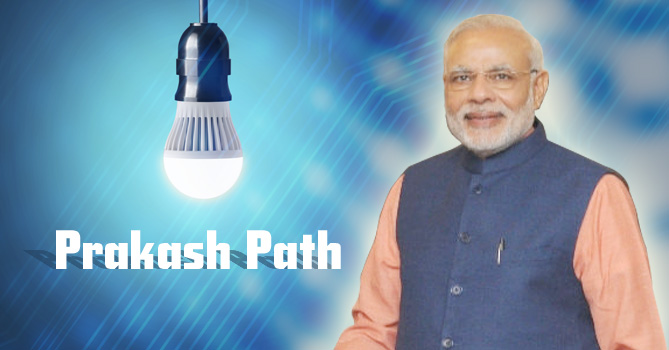
 Prime Minister, Narendra Modi, in a step towards conserving the environment, has launched the Prakash Path (Way to Light), a National Programme for LED-based Home and Street Lighting. Under this scheme, the government is planning to replace 77 crore conventional bulbs and 3.5 crore conventional streetlights with the LED range. As per the Economic Survey 2015-16, this change will see a savings of Rs 45,500 crore by reducing 21,500 MW electricity demand. The Prime Minister replaced one bulb with an LED in the South Block in Delhi. Just replacing all the bulbs in the South Blcok with LED will result in the saving of 7000 units of energy per month.
Advantages of LED Bulbs
LED stands for light-emitting diode (LED). This specialized electronic component is assembled into a lamp or bulb for use in light fixtures. LED bulbs have the following advantages:
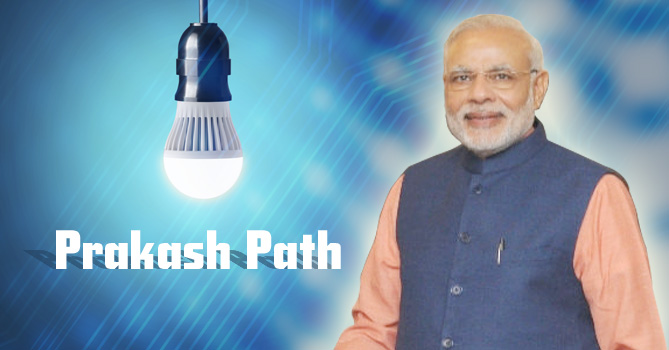
Prime Minister, Narendra Modi, in a step towards conserving the environment, has launched the Prakash Path (Way to Light), a National Programme for LED-based Home and Street Lighting. Under this scheme, the government is planning to replace 77 crore conventional bulbs and 3.5 crore conventional streetlights with the LED range. As per the Economic Survey 2015-16, this change will see a savings of Rs 45,500 crore by reducing 21,500 MW electricity demand. The Prime Minister replaced one bulb with an LED in the South Block in Delhi. Just replacing all the bulbs in the South Blcok with LED will result in the saving of 7000 units of energy per month.
Advantages of LED Bulbs
LED stands for light-emitting diode (LED). This specialized electronic component is assembled into a lamp or bulb for use in light fixtures. LED bulbs have the following advantages:
- LED bulbs are energy efficient. As compared to the incandescent bulbs, LEDs consume up to 90% less power.
- Lesser consumption of power also means lesser emission of CO2, and thus reduced carbon footprints.
- Use of LED bulbs naturally is indicative of a dramatic decrease in power costs.
- LED bulbs are long lasting. A single bulb may last as long as 20 years. Thus usage of the same also results in time-efficiency.
- Money and energy is saved in maintenance and replacement costs due to the long LED lifespan.
- National LED programme was unveiled on January 5, 2015. As of January 15, 2016, 4.77 crore units have been installed under Domestic Efficient Lighting Programme (DELP) and 5.51 lakh units under Street Lighting National Programme (SLNP). This has helped in avoiding 1,547.2 MWs of peak demand.
- The government plans to replace 77 crore incandescent bulbs and 3.5 crore street with energy efficient LED bulbs and lights under DELP and SLNP by March 2019.
- For this, the Energy Efficiency Services Ltd (EESL) along with Discoms, will be distributing LED bulbs to consumers at Rs 10 per unit. This is against the market price of Rs 350-400. The investment, which has been made by EESL, is being recovered from consumers by deduction of installments of Rs 10 every month for 8-12 months.
- This programme will help in mitigating the climate change by reducing the CO2 emission by 85 million tonnes annually.
- National LED programme will also facilitate India's commitment towards reducing its emission intensity per unit of GDP by 33-35 per cent by 2030 under its Intended Nationally Determined Contribution (INDC).
- This change-over will have the positive outcomes of a saving of 45,500 crore accruing to domestic consumers and urban local bodies, annual electricity saving of 109 billion units, and a reduction in demand of 21,000 MW annually.
- At present LED bulbs are only assembled in India. The chips and other essential parts are imported from other nations. The Government of India, consistent with the make in India campaign, plans to encourage the manufacture of LED light fixtures in India.
- Meanwhile, as per budget 2015-2016, the government has slashed the Import Excise duty from 12% to 6% on all inputs for use in manufacture of LED driver and MCPCB for LED lights and Fixtures & LED Lamps.
More Programmes Launched by Modi
Soil Health Card Schemes for Indian Farmers Pradhan Mantri Krishi Sinchai Yojana PM Modi’s Agricultural Reforms Agenda Atal Pension Yojana MUDRA Bank Yojana Start-up India, Stand-up India Sukanya Samriddhi Account Pradhan Mantri Jeevan Jyoti Bima Yojana (PMJJBY) Pradhan Mantri Suraksha Bima Yojana (PMSBY) Pradhan Mantri Kaushal Vikas Yojana Integrated Power Development Scheme (IPDS) Pradhan Mantri Awas Yojana (PMAY) One Rank One Pension Scheme Seventh Pay Commission Garib Kalyan Yojana All Information about Digital India Programme DigiLocker Atal Mission for Rejuvenation and Urban Transformation Mahatma Gandhi National Rural Employment Guarantee Act (MGNREGA) Shyama Prasad Mukherji Rurban Mission (SPMRM) Beti Bachao Beti Padhao Scheme Pahal Scheme Jan Dhan Yojana Skill India Swachh Bharat Abhiyan: Making India Clean & More