 The Indian economy is highly dependent on the agricultural sector. A huge population essentially translates into a need to address the growing food demands each year. This dependency is best seen in a year when a below-normal monsoon sends prices of food items ratcheting up.
Over the past years, fears of the El Nino phenomenon have kept farmers and economists worried. A number of farmer deaths have also been recorded across the country. Most of these are linked to crop failure followed by lack of rainfall and inadequate irrigation. Food and retail inflation are natural corollaries to the situation and this hurts the economy. In 2014-15, foodgrain production in the country dropped by about 5.3 per cent.
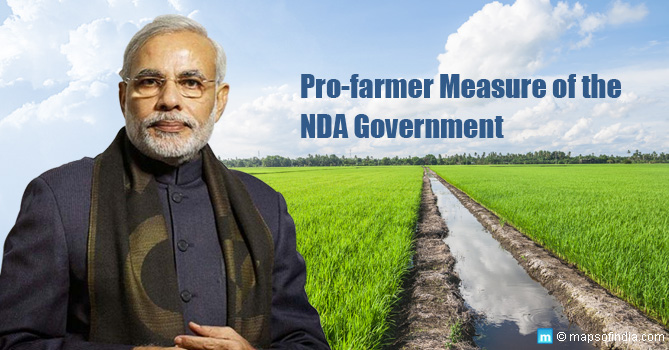
In an attempt to improve the agricultural productivity, the government of India has come up with a new scheme, the Pradhan Mantri Krishi Sinchai Yojana (PMKSY). According to news reports, the Cabinet Committee on Economic Affairs (CCEA), which is chaired by Prime Minister Narendra Modi, finalised the details of the scheme.
Indian Finance Minister Arun Jaitley said that the cabinet has “decided that in 5 years, INR 50,000 crore from the central budget would be utilised for the Pradhan Mantri Krishi Sinchai Yojana. States' share will be over and above this”. The money shall be spent entirely towards improving farm yields and productivity, he said. The spending target, under the scheme, for the current financial year is about INR 5300 crore. This is almost twice the corpus set aside for any agricultural irrigation scheme in earlier budgets. Over and above the central government's allocation, states shall add their funds to the scheme.
If the scheme turns out to be a success, economists and rural managers believe that the crop production could witness a manifold growth.
The Indian economy is highly dependent on the agricultural sector. A huge population essentially translates into a need to address the growing food demands each year. This dependency is best seen in a year when a below-normal monsoon sends prices of food items ratcheting up.
Over the past years, fears of the El Nino phenomenon have kept farmers and economists worried. A number of farmer deaths have also been recorded across the country. Most of these are linked to crop failure followed by lack of rainfall and inadequate irrigation. Food and retail inflation are natural corollaries to the situation and this hurts the economy. In 2014-15, foodgrain production in the country dropped by about 5.3 per cent.
In an attempt to improve the agricultural productivity, the government of India has come up with a new scheme, the Pradhan Mantri Krishi Sinchai Yojana (PMKSY). According to news reports, the Cabinet Committee on Economic Affairs (CCEA), which is chaired by Prime Minister Narendra Modi, finalised the details of the scheme.
Indian Finance Minister Arun Jaitley said that the cabinet has “decided that in 5 years, INR 50,000 crore from the central budget would be utilised for the Pradhan Mantri Krishi Sinchai Yojana. States' share will be over and above this”. The money shall be spent entirely towards improving farm yields and productivity, he said. The spending target, under the scheme, for the current financial year is about INR 5300 crore. This is almost twice the corpus set aside for any agricultural irrigation scheme in earlier budgets. Over and above the central government's allocation, states shall add their funds to the scheme.
If the scheme turns out to be a success, economists and rural managers believe that the crop production could witness a manifold growth.
The Indian economy is highly dependent on the agricultural sector. A huge population essentially translates into a need to address the growing food demands each year. This dependency is best seen in a year when a below-normal monsoon sends prices of food items ratcheting up.
Over the past years, fears of the El Nino phenomenon have kept farmers and economists worried. A number of farmer deaths have also been recorded across the country. Most of these are linked to crop failure followed by lack of rainfall and inadequate irrigation. Food and retail inflation are natural corollaries to the situation and this hurts the economy. In 2014-15, foodgrain production in the country dropped by about 5.3 per cent.
In an attempt to improve the agricultural productivity, the government of India has come up with a new scheme, the Pradhan Mantri Krishi Sinchai Yojana (PMKSY). According to news reports, the Cabinet Committee on Economic Affairs (CCEA), which is chaired by Prime Minister Narendra Modi, finalised the details of the scheme.
Indian Finance Minister Arun Jaitley said that the cabinet has “decided that in 5 years, INR 50,000 crore from the central budget would be utilised for the Pradhan Mantri Krishi Sinchai Yojana. States' share will be over and above this”. The money shall be spent entirely towards improving farm yields and productivity, he said. The spending target, under the scheme, for the current financial year is about INR 5300 crore. This is almost twice the corpus set aside for any agricultural irrigation scheme in earlier budgets. Over and above the central government's allocation, states shall add their funds to the scheme.
If the scheme turns out to be a success, economists and rural managers believe that the crop production could witness a manifold growth.
The Indian economy is highly dependent on the agricultural sector. A huge population essentially translates into a need to address the growing food demands each year. This dependency is best seen in a year when a below-normal monsoon sends prices of food items ratcheting up.
Over the past years, fears of the El Nino phenomenon have kept farmers and economists worried. A number of farmer deaths have also been recorded across the country. Most of these are linked to crop failure followed by lack of rainfall and inadequate irrigation. Food and retail inflation are natural corollaries to the situation and this hurts the economy. In 2014-15, foodgrain production in the country dropped by about 5.3 per cent.
In an attempt to improve the agricultural productivity, the government of India has come up with a new scheme, the Pradhan Mantri Krishi Sinchai Yojana (PMKSY). According to news reports, the Cabinet Committee on Economic Affairs (CCEA), which is chaired by Prime Minister Narendra Modi, finalised the details of the scheme.
Indian Finance Minister Arun Jaitley said that the cabinet has “decided that in 5 years, INR 50,000 crore from the central budget would be utilised for the Pradhan Mantri Krishi Sinchai Yojana. States' share will be over and above this”. The money shall be spent entirely towards improving farm yields and productivity, he said. The spending target, under the scheme, for the current financial year is about INR 5300 crore. This is almost twice the corpus set aside for any agricultural irrigation scheme in earlier budgets. Over and above the central government's allocation, states shall add their funds to the scheme.
If the scheme turns out to be a success, economists and rural managers believe that the crop production could witness a manifold growth.