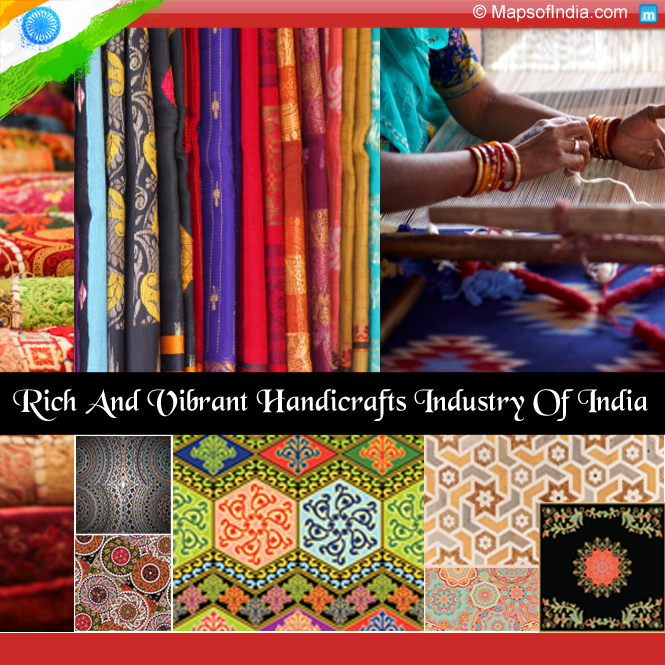
 Vibrant And Rich Handicrafts of India[/caption]
The handicrafts industry of India essentially mirrors the aspects of the age old civilization of India. No wonder the phrase ‘unity in diversity’ is so applicable to our country. Each state has its unique handicraft products; so the diverse nature of the Indian handicraft industry is evident. The entire industry, being decentralized, is spread all over this huge subcontinent, concentrated both in the rural and urban areas. The Indian handicraft industry essentially falls under the cottage industry category. Despite this fact, it is a high employment intensive sector, employing over 6 million part time and full time artisans (inclusive of the carpet manufacturing sector), including women and a large section from the weaker strata of the society. Besides being an employment generator, the handicraft industry is economically extremely viable, because very low capital investments are necessary while the potential for export of the various handicraft products is considerable and that makes this industry an important foreign exchange earner of our country.
However, the handicraft industry still remains unexplored to a great extent and the full potential of this industry is yet to be tapped. This is evident from the fact that although India ranks as an important handicrafts exporter in the world market, it forms only an iota of the handicrafts export in the global scenario. Some of the important hubs of the Indian handicrafts industry are Moradabad (also known as the ‘Peetalnagari’- city of brass, noted for its brass artifacts), Saharanpur (noted for its wooden artifacts), and Ferozabad (noted for its exclusive glass handicrafts), in Uttar Pradesh. Other important handicraft producing hubs are Jaipur (famous for its exotic quilts), Bagru and Sanganer (printed textiles) and of course, Jodhpur (famous for its unique wooden and wrought iron furniture), in north western Rajasthan. Kutch (the coastal state of Gujarat) also needs a special mention because of its exotic embroidered handicrafts and Narsapur (Andhra Pradesh) famous for its lace handicrafts. These are only some of the well known handicrafts of India, the actual list of which is practically endless.
Some popular categories of Indian handicrafts are:
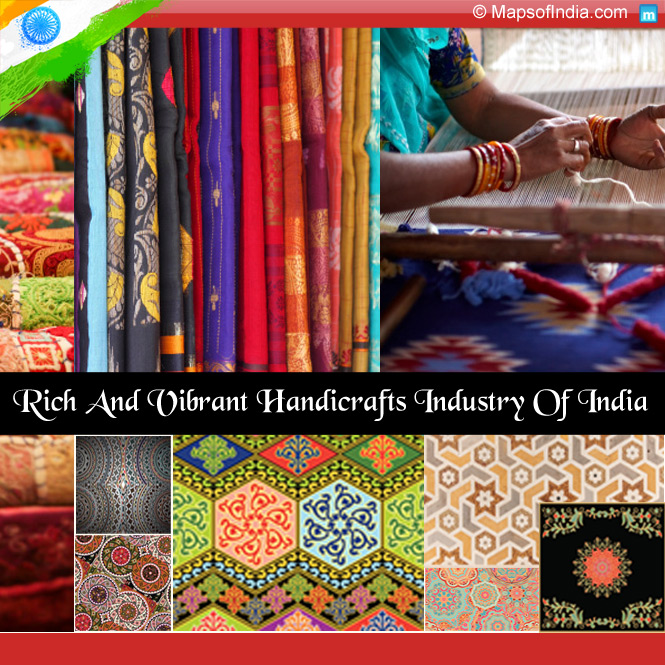
Vibrant And Rich Handicrafts of India[/caption]
The handicrafts industry of India essentially mirrors the aspects of the age old civilization of India. No wonder the phrase ‘unity in diversity’ is so applicable to our country. Each state has its unique handicraft products; so the diverse nature of the Indian handicraft industry is evident. The entire industry, being decentralized, is spread all over this huge subcontinent, concentrated both in the rural and urban areas. The Indian handicraft industry essentially falls under the cottage industry category. Despite this fact, it is a high employment intensive sector, employing over 6 million part time and full time artisans (inclusive of the carpet manufacturing sector), including women and a large section from the weaker strata of the society. Besides being an employment generator, the handicraft industry is economically extremely viable, because very low capital investments are necessary while the potential for export of the various handicraft products is considerable and that makes this industry an important foreign exchange earner of our country.
However, the handicraft industry still remains unexplored to a great extent and the full potential of this industry is yet to be tapped. This is evident from the fact that although India ranks as an important handicrafts exporter in the world market, it forms only an iota of the handicrafts export in the global scenario. Some of the important hubs of the Indian handicrafts industry are Moradabad (also known as the ‘Peetalnagari’- city of brass, noted for its brass artifacts), Saharanpur (noted for its wooden artifacts), and Ferozabad (noted for its exclusive glass handicrafts), in Uttar Pradesh. Other important handicraft producing hubs are Jaipur (famous for its exotic quilts), Bagru and Sanganer (printed textiles) and of course, Jodhpur (famous for its unique wooden and wrought iron furniture), in north western Rajasthan. Kutch (the coastal state of Gujarat) also needs a special mention because of its exotic embroidered handicrafts and Narsapur (Andhra Pradesh) famous for its lace handicrafts. These are only some of the well known handicrafts of India, the actual list of which is practically endless.
Some popular categories of Indian handicrafts are:
- Metal Craft: This process involves molding of soft metals like silver, brass, copper and gold into a consummate range of artifacts like jewellery, statuettes, and utensils. This type of handicraft is typical of Assam, Bihar, Tamilnadu, Orissa, West Bengal, Kerala and Kashmir.
- Metal Surface Decorations: This range of handicrafts popularly known as Bidri involves extensive use of appliqué inlays and overlays. The surface is generally covered with gold and silver inlays. The technique of ‘Enameling’ also falls under this category of handicrafts involving metal surfaces first coated with colour layers followed by complex etchings on these layers.
- Pottery: Manufactured mainly by the potters and artisans of Kutch, Alwar, Jaipur, Saurashtra, Bikanir, Kangra, Khujra, Hapur and Meerut, this form of handicraft involves shaping pottery clay into an interesting and utilitarian range of pottery.
- Stone Craft: This form of handicraft involves molding of various stones through grinding, cutting and finally polishing them into varied forms of stoneware, candle stands, lampshades etc., a hallmark of the handicrafts of Bihar, Varanasi, Tamil Nadu, Agra and Vrindavan.
- Terracotta: The art of baking clay into an excellent range of receptacles like jars, small utilitarian furniture, figurines and jewellery.
- Woodcraft: This handicraft involves art of exquisite carving of various wood types into wall hanging plaques, furniture, idols, etc mainly practiced by the artisans of Jammu, Kashmir, Uttar Pradesh, Gujarat, Karnataka and Kerala. The woods used range from sandalwood to teakwood and shisham.
- Hand Crafted Jewellery: This is a handicraft that requires tremendous skill. It involves carving of a conspicuous range of jewellery using stones ranging from pearls to amethyst, an undisputed example of the creative calibre of Indian craftsmen. Both precious and semi precious stones are used in this form of handicraft.
- Paintings: This realm of handicraft encompasses almost all kind of painting including floor paintings. The Madhubani paintings of Bihar, reproductions of the Mughal Miniatures of UP and Rajasthan and Phad paintings need special mention in this realm.
- Textiles: The textile based handicrafts of India are simply fabulous which can be attributed to their skillful weaving, vivid colour schemes and innovative designs. The fascinating range of hand woven fabrics include muslin and Indian silk, while some excellent examples of hand printed fabrics include block or screen painted fabrics, kalamkari and batik.
- Cane Handicrafts: This form of handicraft involves creating a matchless range of furniture fashioned from cane by the Indian craftsmen that are utilitarian, trendy yet reflects the spirit of rural India. Moonj is also used in this handicraft. Baskets weaved from moonj need a special mention.
- Carpets and Durries: This form of handicraft basically deals with floor coverings. Especially notable are the Indian carpets, a quality product available in varieties like Persian, Aubusson and Turkoman. Because of their matchless weaving, vivid colour patterns and inimitable designs, these carpets are of great demand in the global market. Floor coverings fashioned out of durries and jute are also a part of this handicraft and are extensively noted for their elegance.