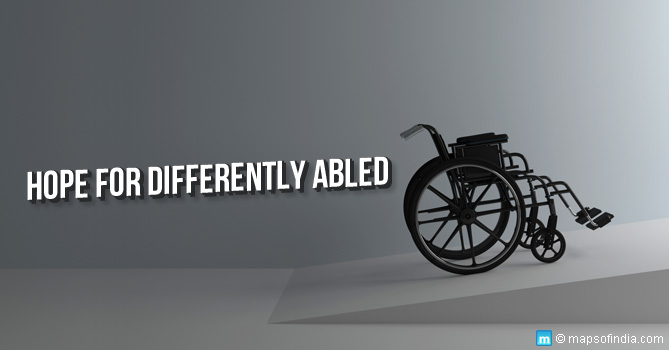
 Prime Minister Narendra Modi launched the much awaited “Accessible India Campaign” or “Sugamya Bharat Abhiyan” on 3 December 2015 - the day designated as the “International Day of Persons with Disabilities”. This is a bid by the government to make India more friendly towards the differently abled. The campaign has been launched with the sole objective to empower the differently-abled people to move about and travel easily in public places.
Objectives
“Making public space, transport, tourist places, airports, railway stations and information and communication technology in the country differently-able friendly”.
The campaign emphasizes that all persons with disabilities (PwDs) should have equal opportunities to live independently and participate in all aspects of life as every other in the society so as to make their lives productive, safe and dignified.
A nation-wide awareness campaign in creating a barrier-free environment and for attaining universal accessibility for all PwDs was long pending. With this intention in mind, the Department of Empowerment of Persons with Disabilities (DEPwD), Ministry of Social Justice & Empowerment, has come up with this “Accessible India Campaign (Sugamya Bharat Abhiyan)” as a nation-wide flagship drive.
Action Plan
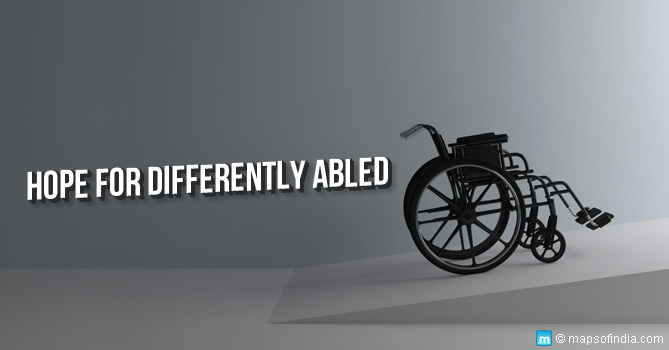
Prime Minister Narendra Modi launched the much awaited “Accessible India Campaign” or “Sugamya Bharat Abhiyan” on 3 December 2015 - the day designated as the “International Day of Persons with Disabilities”. This is a bid by the government to make India more friendly towards the differently abled. The campaign has been launched with the sole objective to empower the differently-abled people to move about and travel easily in public places.
Objectives
“Making public space, transport, tourist places, airports, railway stations and information and communication technology in the country differently-able friendly”.
The campaign emphasizes that all persons with disabilities (PwDs) should have equal opportunities to live independently and participate in all aspects of life as every other in the society so as to make their lives productive, safe and dignified.
A nation-wide awareness campaign in creating a barrier-free environment and for attaining universal accessibility for all PwDs was long pending. With this intention in mind, the Department of Empowerment of Persons with Disabilities (DEPwD), Ministry of Social Justice & Empowerment, has come up with this “Accessible India Campaign (Sugamya Bharat Abhiyan)” as a nation-wide flagship drive.
Action Plan
- The campaign targets three verticals in the first phase. These include the built-up environment, information & communication eco-system, and transportation eco-system.
- The campaign has stipulated timelines and will make use of social media and IT for creating awareness among the masses.
- The campaign has also been seeking commitment and engagement of various partners like government officers, professionals, students and others.
- State governments have to select about 50 to 100 public buildings in big cities and shortlist citizen-centric public websites that have to be converted to disabled friendly after proper auditing by professional agencies. All these will be supported by the Scheme of Implementation of Persons with Disabilities Act (SIPDA), a subsidiary scheme under DEPwD.
- In collaboration with the Ministry of Home, the Family Welfare and Ministry of Tourism, and the Ministry of Health, DEPwD will create ‘accessible police stations’, ‘accessible hospitals’ and ‘accessible tourism’ across the country.
- Ministry of Information and Broadcasting will also incorporate features like captioning, audio description for enhancing accessibility to television broadcasts.
- The department will create a web portal along with a mobile app in English, Hindi and all Regional languages to comprehensively obtain information of nearby accessible places across the country and also about inaccessible places.
- The mobile app will also allow any person to click a photograph or video of any public place that is inaccessible and upload the same on the portal so that necessary steps can be taken to make it accessible.
- The mobile app will also have the provision of evaluating the accessible place by the users.
- Persons with Disabilities (Equal Opportunities, Protection of Rights and Full Participation) PwD Act, 1995 provides for non-discrimination in transport, on the road and in-built environment under Sections 44, 45 and 46, respectively. As per Section 46 of the PwD Act, the States are required to provide for :
- Ramps in public buildings
- Availability of toilets for wheelchair users
- Braille symbols and auditory signals should be available in lifts
- Ramps should be available in hospitals, primary health centres and other rehabilitation centres.
- India is already a signatory of United Nations Convention on the Rights of Persons with Disabilities (UNCRPD) under Article 9 which make it the Governments’ responsibilities for ensuring PwDs easy access to transportation, information, physical environment, communication technology services as well as emergency services.