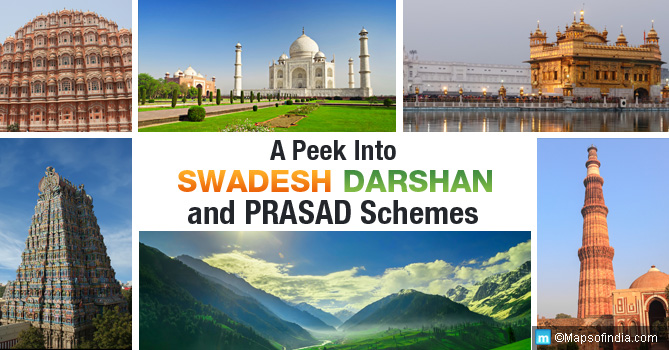
 India is a vast country with a rich and diverse heritage of religions, communities, culture, traditions and bio-diversity, all of which offer a wide choice of options for the keen traveller.
To nurture this diverse heritage and to promote interest among tourists, both domestic and international, the Narendra Modi-led government took the initiative to allocate financial and other resources in the 2014-15 Budget for developing ‘theme-based’ tourist circuits in India.
Swadesh Darshan
The Objective
Identify and develop theme-based tourist circuits based on interest, sustainability and competitiveness, by integrating resources and local participation of state and local communities.
Theme-based high-interest tourist circuits to include:
India is a vast country with a rich and diverse heritage of religions, communities, culture, traditions and bio-diversity, all of which offer a wide choice of options for the keen traveller.
To nurture this diverse heritage and to promote interest among tourists, both domestic and international, the Narendra Modi-led government took the initiative to allocate financial and other resources in the 2014-15 Budget for developing ‘theme-based’ tourist circuits in India.
Swadesh Darshan
The Objective
Identify and develop theme-based tourist circuits based on interest, sustainability and competitiveness, by integrating resources and local participation of state and local communities.
Theme-based high-interest tourist circuits to include:
- Pilgrimage and Spirituality – India has a long history of opening itself to all religions and today, each has a vast following in India and overseas. Pilgrimage sites for Hindus, Sufis, Buddhists, Sikhs, Christians, etc., all offer tremendous potential for development.
- Heritage – Historical places beginning with the Taj Mahal, Red Fort (Delhi), Ajanta Caves, the temples of South, etc., all have tremendous potential for further development.
- Culture – Themes around festivals, fairs, cattle fairs, community fairs, all continue to attract large number of tourists each year.
- Eco-tourism – Preserve and promote bio-diversity and ecological conservation through responsible tourism.
- The Himalayan Circuit
- The Coastal Circuit
- The North-East India Circuit
- The Buddhist Circuit
- The Desert Circuit
- The Krishna Circuit
- The Tribal Circuit
- The Ramayana Circuit
- The Spiritual Circuit
- The Eco Circuit
- The Heritage Circuit
- The Wildlife Circuit
- The Rural Circuit
- Create local awareness of the value of local history, heritage, culture, tradition and the importance of outsider interest to know these aspects.
- Involve local youth and communities to train them for direct and indirect employment opportunities in promoting tourism in their area.
- Invest in local infrastructure development to ensure an high-quality of comfort, convenience and access to all tourists.
- Promote local arts and crafts to add value to the tourist experience.
- Involve states to develop integrated strategies with support and guidance from the central government.
- Increased local employment opportunities to generate more incomes and lead to an improved quality of life.
- Preservation of local culture, tradition and customs.
- Development of hotels, guest houses and home-stay opportunities.
- Development of tourism-related service support infrastructure like transport, catering, excursions and retail.
- The Himalayan Circuit: Rs 569.19 crore
- The Coastal Circuit: Rs 414.26 crore
- The Tribal Circuit: Rs 116.55 crore
- The North-East Circuit: Rs 194.45 crore
- Ramayana Circuit
- Krishna Circuit
- Buddhist Circuit
- Spiritual Circuit
- Amritsar, Punjab
- Kedarnath, Uttarakhand
- Badrinath, Uttarakhand
- Katra, J&K
- Hazratbal, J&K
- Mathura, U.P
- Ajmer, Rajasthan
- Somnath, Gujarat
- Trimbakeshwar, Maharashtra
- Varanasi, U.P
- Ujjain, M.P
- Gaya, Bihar
- Patna, Bihar
- Belur, West Bengal
- Deogarh, Jharkhand
- Kamakhya, Assam
- Puri, Odisha
- Tirupati, Andhra Pradesh
- Amravati, Andhra Pradesh
- Srisailam, Andhra Pradesh
- Kanchipuram, Tamil Nadu
- Vellankanni, Tamil Nadu
- Guruvayoor, Kerala
- Government plans to encourage development of budget hotels/hotel chains that offer clean and comfortable experience to the pilgrim at an affordable cost.
- Establish travel access points for international and domestic tourists to arrive through air, rail and road.
- Improve local sanitation and sewerage systems along with making clean drinking water available to all.
- Develop last-mile connectivity by encouraging local participation in getting involved in providing low-cost, clean and affordable local transport.
- Train local youth with the aim of creating more employment opportunities in all services related support infrastructure.
- Promote local arts and crafts; encourage presentation of local culture of dance, music and costume through performances; promote local cuisines through training; and encourage more retail points to serve tourists.
- Dwarka, Gujarat – Rs 26.23 crore
- Kanchipuram, Tamil Nadu: Rs 16.48 crore
- Vellankanni, Tamil Nadu: Rs 5.60 crore
- Belur, West Bengal: Rs 30.03 crore
- Hazratbal, J&K: Rs 42.02 crore