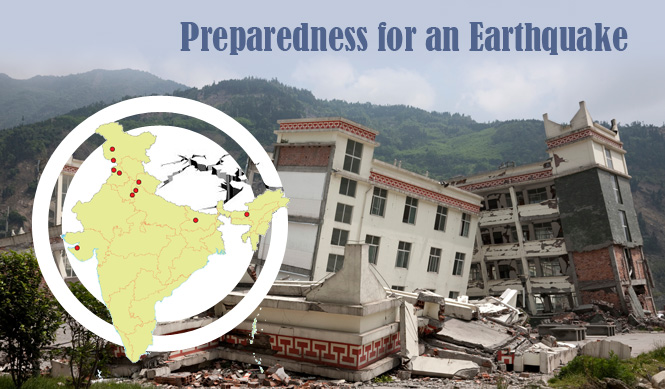
 The outermost crust of earth is made of tectonic plates, with edges marked by faults. These plates are in constant motion. An earthquake occurs along the fault lines of these plates, when they slide past each other or collide. The location on the tectonic plates where the collision occurs is the hypocentre, while the surface area of earth directly above the hypocentre is the epicentre of the earthquake. Earthquake results in violent shaking of the ground, and leads to collapsing buildings and bridges. Sometimes the magnitude is large enough to trigger even landslides, avalanches, and tsunamis.
The outermost crust of earth is made of tectonic plates, with edges marked by faults. These plates are in constant motion. An earthquake occurs along the fault lines of these plates, when they slide past each other or collide. The location on the tectonic plates where the collision occurs is the hypocentre, while the surface area of earth directly above the hypocentre is the epicentre of the earthquake. Earthquake results in violent shaking of the ground, and leads to collapsing buildings and bridges. Sometimes the magnitude is large enough to trigger even landslides, avalanches, and tsunamis.
The outermost crust of earth is made of tectonic plates, with edges marked by faults. These plates are in constant motion. An earthquake occurs along the fault lines of these plates, when they slide past each other or collide. The location on the tectonic plates where the collision occurs is the hypocentre, while the surface area of earth directly above the hypocentre is the epicentre of the earthquake. Earthquake results in violent shaking of the ground, and leads to collapsing buildings and bridges. Sometimes the magnitude is large enough to trigger even landslides, avalanches, and tsunamis.